VOLTAGE
REGULATOR
ADJUSTMENTS
Description
The
voltage regulator is an advanced design which ensures
optimum
AC
alternator performance. It is equipped with
complete protection circuitry to guard against operating
conditions that could
be detrimental to the
AC
alternator.
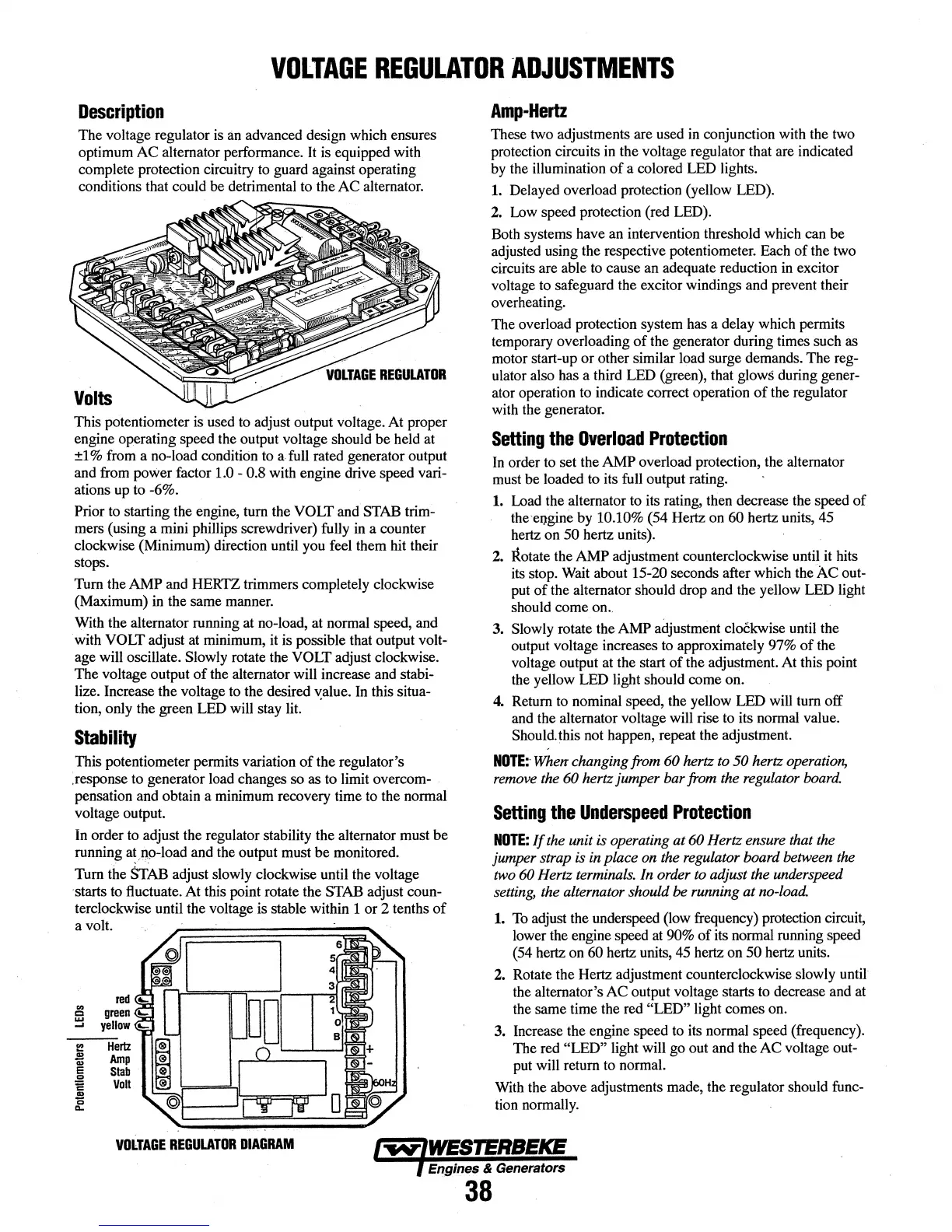
Volts
This potentiometer is used to adjust output voltage. At proper
engine operating speed the output voltage should
be
held at
±1% from a no-load condition to
a.
full rated generator output
and from
power factor 1.0 - 0.8 with engine drive speed vari-
ations up to -6%.
Prior to starting the engine,
tum
the VOLT and STAB trim-
mers (using a mini phillips screwdriver) fully in a counter
clockwise (Minimum) direction until you feel them hit their
stops.
Thm
the
AMP
and HERTZ trimmers completely clockwise
(Maximum) in the same manner.
With the alternator running at no-load, at normal speed, and
with
VOLT adjust at minimum, it is possible that output volt-
age will oscillate.
Slowly rotate the VOLT adjust clockwise.
The
voltage output
of
the alternator will increase and stabi-
lize. Increase the voltage to the desired
~alue.
In this situa-
tion, only the green LED will stay lit.
Stability
This potentiometer permits variation
of
the regulator's
. response to generator load changes so as to limit overcom-
pensation and obtain a minimum recovery time to the normal
voltage output.
In order to adjust the regulator stability the alternator must be
running
~
JlJl-load and the output must be monitored.
Tum
the STAB adjust slowly clockwise until the voltage
·starts to fluctuate.
At
this point rotate the STAB adjust coun-
terclockwise until the voltage is stable within 1
or
2 tenths
of
a volt.
red
e
green
._
-'
yellow..._
i
I
....
Hertz
Amp
Stab
Volt
VOLTAGE
REGULATOR
DIAGRAM
Amp-Hertz
These two adjustments are used in conjunction with the two
protection circuits in the voltage regulator that are indicated
by the illumination
of
a colored LED lights.
1.
Delayed overload protection (yellow LED).
2. Low speed protection (red LED).
Both systems have an intervention threshold which can
be
adjusted using the respective potentiometer. Each
of
the two
circuits are able to cause
an
adequate reduction in excitor
voltage to safeguard the excitor windings and prevent their
overheating.
The overload protection system has a delay which permits
temporary overloading
of
the generator during times such as
motor start-up
or
other similar load surge demands. The reg-
ulator also has a third LED (green), that
glows during gener-
ator operation to indicate correct operation
of
the regulator
with the generator.
Setting
the
Overload
Protection
In
order to set the
AMP
overload protection, the alternator
must
be
loaded
to
its full output rating.
1. Load the alternator to its rating, then decrease the speed
of
the·el}gine by 10.10% (54 Hertz on
60
hertz units, 45
hertz
on
50
hertz units).
2. Rotate the
AMP
adjustment counterclockwise until it hits
its stop. Wait about
15-20 seconds after which the
AC
out-
put
of
the alternator should drop and the yellow LED light
should come on
..
3. Slowly rotate the
AMP
adjustment clockwise until the
output voltage increases to approximately 97%
of
the
voltage output at the start
of
the adjustment.
At
this point
the yellow LED light should come on.
4.
Return to nominal speed, the yellow LED will tum off
and the alternator voltage will rise
to
its normal value.
Should this not happen, repeat the adjustment.
NOTE:·
When changing
from
60 hertz to 50 hertz operation,
remove
the 60 hertz jumper bar
from
the regulator board .
Setting
the
Underspeed
Protection
NOTE:
If
the
unit
is
operating at 60 Hertz ensure that
the
jumper strap is
in
place
on
the regulator board between the
two
60 Hertz terminals.
In
order
to
adjust the underspeed
setting,
the alternator should be running at
no-load.
1.
To adjust the underspeed (low frequency) protection circuit,
lower the engine speed at
90%
of
its normal running speed
(54 hertz on
60 hertz units, 45 hertz
on
50
hertz units.
2. Rotate the Hertz adjustment counterclockwise slowly until
the alternator's
AC
output voltage starts to decrease and at
the same time the red
"LED"
light comes on.
3. Increase the engine speed to its normal speed (frequency).
The red
"LED"
light will go out and the
AC
voltage out-
put will return to normal.
With the above adjustments made, the regulator should func-
tion normally .
Engines
&
Generators
38



 To Next Page