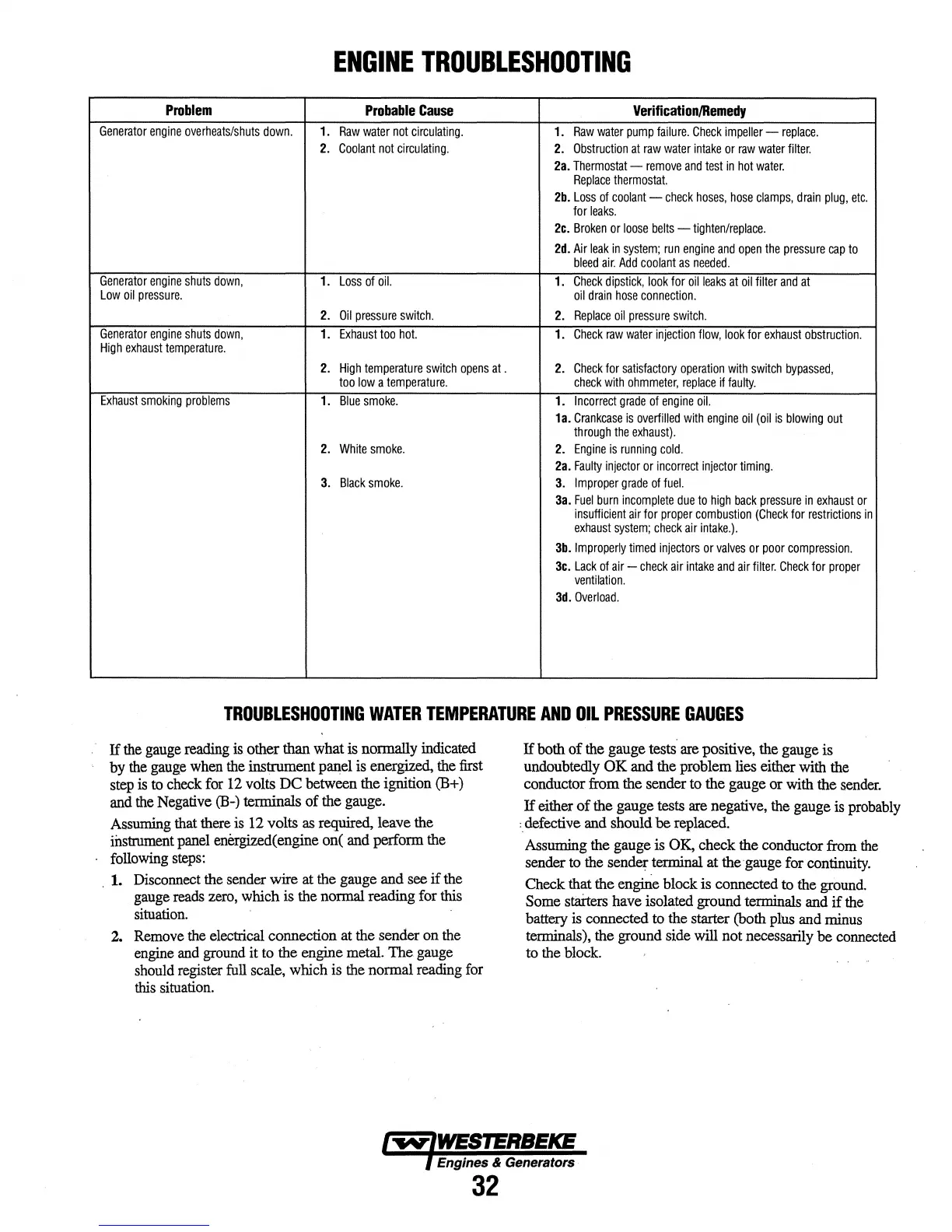
ENGINE
TROUBLESHOOTING
Problem
Probable
Cause
VerificationJRemedy
Generator
engine
overheats/shuts
down.
1.
Raw
water
not
circulating.
1.
Raw
water
pump
failure.
Check
impeller-
replace.
2.
Coolant
not
circulating.
2.
Obstruction
at
raw
water
intake
or
raw
water
filter.
2a.
Thermostat-
remove
and
test
in
hot
water.
Replace
thermostat.
2b.
loss
of
coolant-
check
hoses,
hose
clamps,
drain
plug,
etc.
for
leaks.
2c.
Broken
or
loose
belts-
tighten/replace.
2d.
Air
leak
in
system;
run
engine
and
open
the
pressure
cap
to
bleed
air.
Add
coolant
as
needed.
Generator
engine
shuts
down,
1.
loss
of
oil.
1.
Check
dipstick,
look
for
oil
leaks
at
oil
filter
and
at
low
oil
pressure.
oil
drain
hose
connection.
2.
Oil
pressure
switch.
2.
Replace
oil
pressure
switch.
Generator
engine
shuts
down,
1.
Exhaust
too
hot.
1.
Check
raw
water
injection
flow,
look
for
exhaust
obstruction.
High
exhaust
temperature.
2.
High
temperature
switch
opens
at.
2.
Check
for
satisfactory
operation
with
switch
bypassed,
too
low
a
temperature.
check
with
ohmmeter,
replace
if
faulty.
Exhaust
smoking
problems
1.
Blue
smoke.
1.
Incorrect
grade
of
engine
oil.
1a.
Crankcase
is
overfilled
with
engine
oil
(oil
is
blowing
out
through
the
exhaust}.
2.
White
smoke.
2.
Engine
is
running
cold.
2a.
Faulty
injector
or
incorrect
injector
timing.
3.
Black
smoke.
3.
Improper
grade
of
fuel.
3a.
Fuel
burn
incomplete
due
to
high
back
pressure
in
exhaust
or
insufficient
air
for
proper
combustion
(Check
for
restrictions
in
exhaust
system;
check
air
intake.}.
3b.
Improperly
timed
injectors
or
valves
or
poor
compression.
3c.
lack
of
air
-
check
air
intake
and
air
filter.
Check
for
proper
ventilation.
3d.
Overload.
TROUBLESHOOTING
WATER
TEMPERATURE
AND
OIL
PRESSURE
GAUGES
If
the gauge reading is other
than
what is nonnally indicated
by
the
gauge
when
the instrument panel is energized,
the
first
step
is
to check for 12 volts
DC
between the ignition (B+)
and
the
Negative (B-) terminals of the gauge.
Assuming
that there
is
12 volts as required, leave the
instrument panel energized( engine on( and perform the
following
steps:
1. Disconnect the sender wire at the gauge and see
if
the
gauge reads
zero,
which is the normal reading for this
situation.
2. Remove the electrical connection at the sender on the
engine and ground it
to
the engine metal. The gauge
should register
full
scale, which is the normal reading
for
this
situation.
If
both
of
the gauge
tests.
are positive, the gauge is
undoubtedly
OK
and
the problem lies either with the
conductor from
the
sender
to
the gauge or with the
sender.
If
either
of
the gauge tests are negative, the gauge
is
probably
'.defective and should
be replaced.
Assuming the gauge is
OK,
check the conductor from
the
sender
to
the sender terminal at the ·gauge for continuity.
Check that the engine block is connected
to the ground.
Some starters have isolated ground terminals and
if
the
battery
is
connected to the starter (both plus and minus
terminals), the ground side will not necessarily
be
connected
to
the block.
Engines
&
Generators
32



 To Next Page