62
EN
Adjusting the brakes on the woom ORIGINAL
If the brake pads scrape against the braking surface of the rim, the brake lever can be pulled
all the way back to the handlebar grip or the braking eect is too low, the brakes on the woom
ORIGINAL can be adjusted according to the instructions in the following chapters. To adjust
the brake lever position and the brake lever reach, see Chapter 7.
WARNING
The brake levers must be adjusted so that your child can reach them and brake safely.
After every adjustment, check the brakes for proper function and braking eciency.
Check that the wheels rotate freely without resistance by lifting the front and back
wheel o the ground. The brake pads and other parts of the brakes must not rub
against the tyre or the braking surface.
The brake lever must never return fully to the handlebar grips when the brake is ap-
plied. The braking eect must be suciently high to allow safe stopping at all times.
Failure to observe this information can result in material damage, severe damage to
health (danger to life) or death.
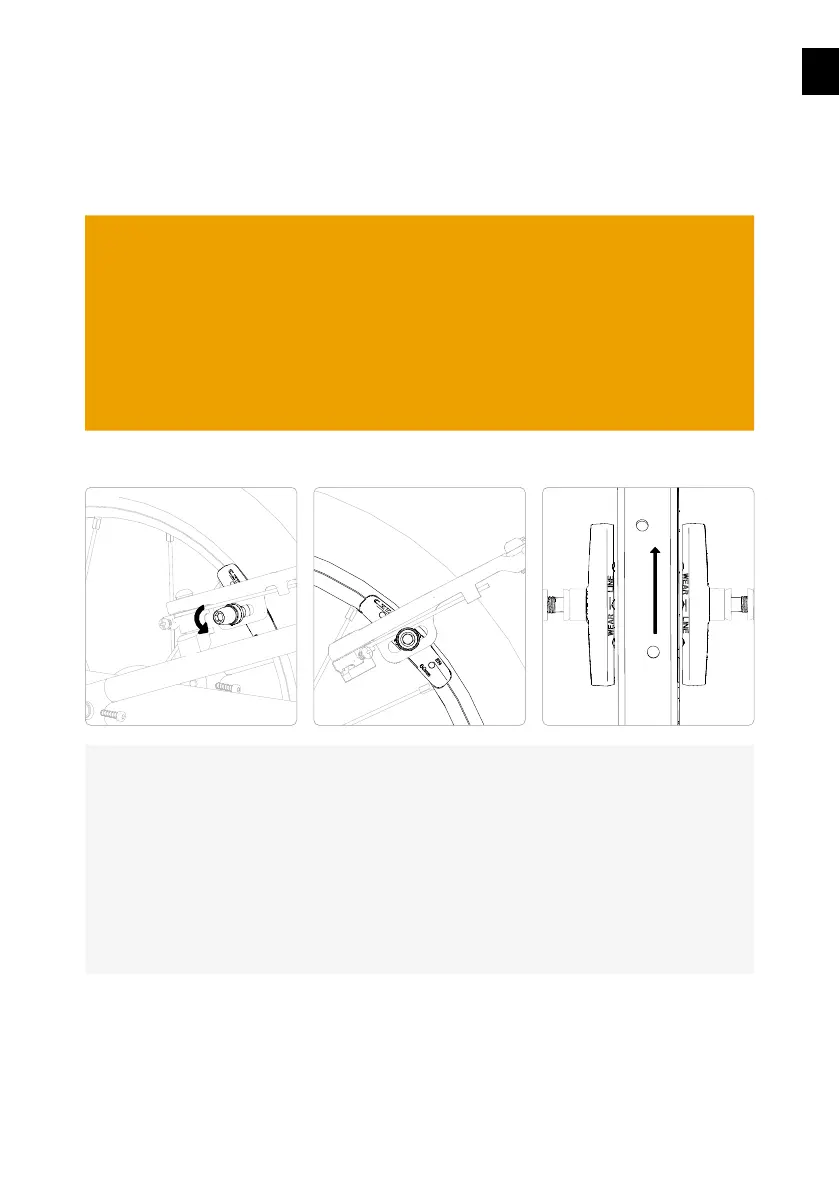
Adjusting the position of the brake pads on the woom ORIGINAL
To adjust the brake pad posi-
tion, loosen the retaining bolt
of the left or right brake pad
so that the brake pad can be
positioned or rotated.
When adjusting, always loosen
only one brake pad at a time.
Align the brake pads so that
they rest centrally on and are
parallel to the braking surface
of the rim.
To check for correct positio-
ning, pull lightly on the hand-
brake lever so that the brake
pads rest against the rim. The
brake pads must never touch
the tyre or protrude from the
underside of the braking sur-
face.
When adjusting the brake
pads, also make sure that
they are parallel to the rim
lengthwise.
The distance between the bra-
ke pads and the rim must be
uniform along the length of the
brake pads.
FRONT


 To Next Page
 Loading...