Page 15
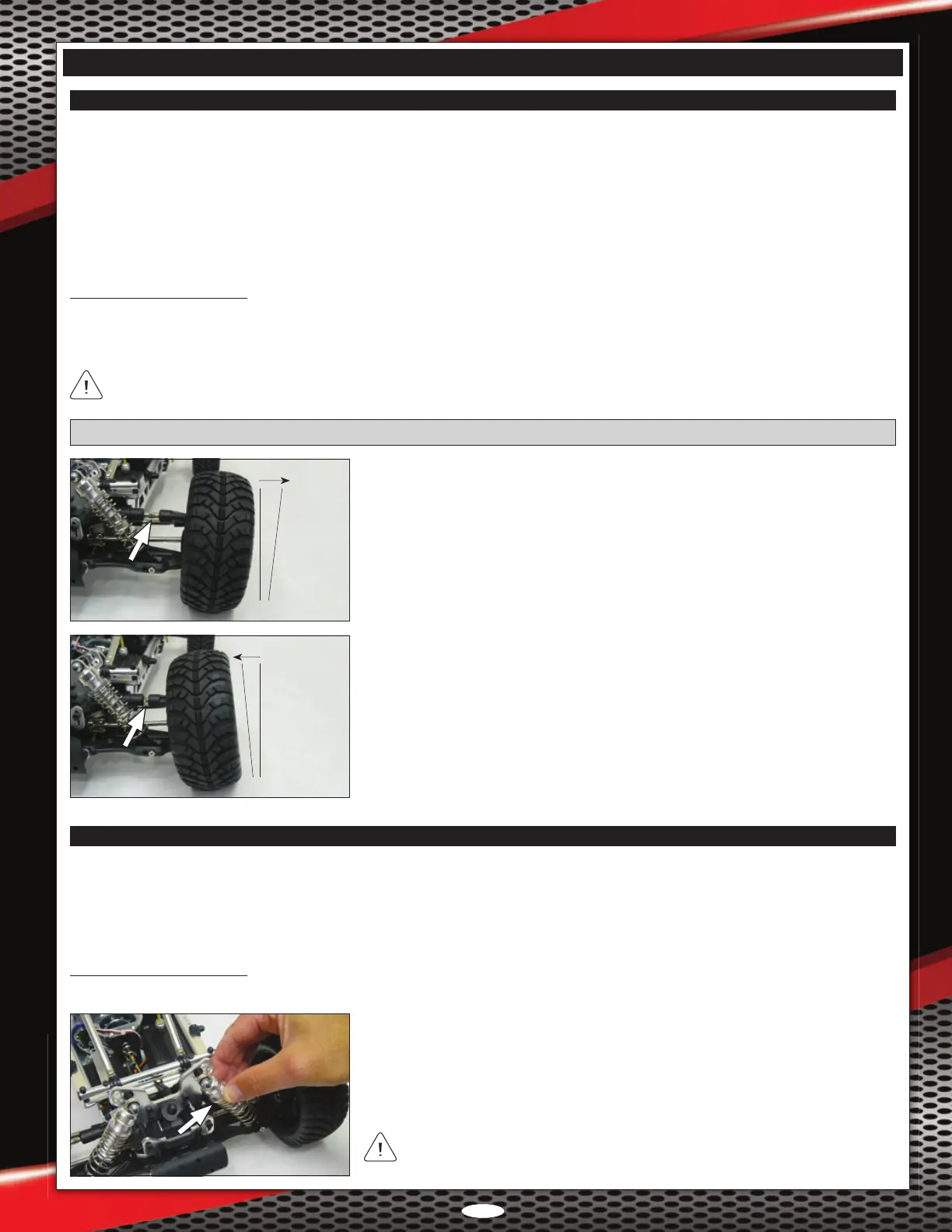
Camber is referred to as the amount of the tyre's surface that contacts the ground. Tyres that are exactly perpendicular to the ground
have 0 degrees of camber. If the top of the tyre leans in toward the chassis, the tyre has negative camber. If the top of the tyre leans
out away from the chassis, the tyre has positive camber.
l
Camber angle should be adjusted to ensure maximum tyre contact between the ground and the tyres for your particular track. You
can check to ensure maximum tyre contact by rst cleaning your tires, then by running the Rail on your track. After running, check the
dirt and/or wear marks on the tyre. Adjust the camber angle if the dirt and/or wear marks are more toward the outside or the inside of
the tyre.
n
Adjusting Camber Angle - Front and Rear
ChASSIS TUNING GUIDE
l
For driving on smooth surfaces set both the front and back tyres at 0 degrees.
l
For driving on rough surfaces set the front tyres at -1 degree and the back tyres at -2 degrees.
q To increase positive camber angle, use an adjustable wrench to turn the upper
turnbuckles and lengthen the upper suspension arm assembly and push the top of
the tyres out.
Camber settings should be measured with the Rail at its normal ride height.
PRO TIP: For more precise camber adjustments, use a dedicated camber gauge, available at most hobby retailers.
By adjusting the spring tension of the shocks, you can increase steering sensitivity, adjust the ride-height of the Rail, and ne-tune the
damping quality of the suspension system. How you drive your Rail will dictate what settings you should be using.
As an example, if you're driving your Rail off-road and going over lots of jumps, you may want to increase the spring tension of the front
shocks to help prevent the front of the Rail from bottoming out. If you're racing your Rail, local track conditions will dictate the settings to use.
n
Adjusting Shock Spring Tension - Front and Rear
l
We recommend initially leaving each of the adjustment rings in the factory positions.
q Increase or decrease spring tension by threading the adjustment ring up or down
the shock body. Threading the adjustment ring down (clockwise) increases spring
tension and the chassis's ride height, and will stiffen the overall damping characteristics
of the suspension. Threading the adjustment ring up (anti-clockwise) decreases spring
tension and makes the damping characteristics of the suspension softer.
When adjusting the spring tension, make sure to adjust the right and left shocks
equally.
Positive
Camber
Negative
Camber
q To increase negative camber angle, use an adjustable wrench to turn the upper
turnbuckles and shorten the upper suspension arm assembly and pull the top of the
tyres in.





 To Next Page