Page 17
ChASSIS TUNING GUIDE
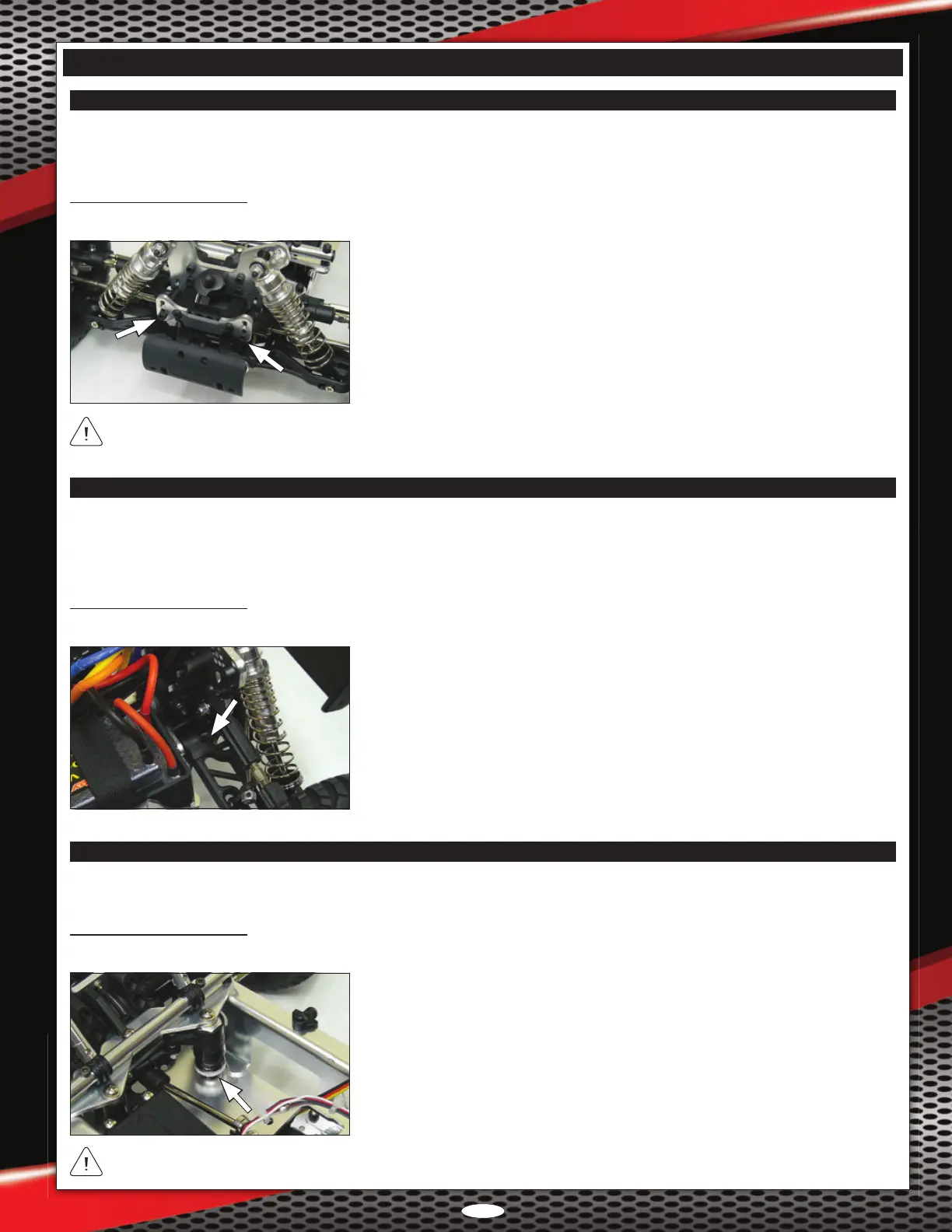
The front upper hinge pins can be moved up or down to adjust bump steer. Generally, if you move the hinge pins into a lower position,
this will increase bump steer, which can be helpful on tight tracks. For a larger track, you may want to move the hinge pins to a higher
position to decrease bump steer.
n
Adjusting Bump Steer - Front
l
We recommend initially leaving the front upper hinge pins in the factory locations.
q Adjust bump steer by removing the upper hinge pins and reinstalling them, along with
the upper suspension arms, in a hole either further up or lower down in the upper
suspension plate.
When tightening the hex nuts on the back of the hinge pins, be careful not to overtighten them or the suspension arms may not
pivot freely. Make sure to adjust the right and left sides equally.
You can adjust your Rail's steering sensitivity by tightening or loosening the servo saver spring. In general, tightening the servo saver
spring will cause the steering to be more responsive, and loosening the servo saver spring will cause the steering to be less responsive.
n
Adjusting Steering Sensitivity - Front
l
We recommend initially leaving the servo saver adjustment ring in the factory position.
q To access the servo saver spring, remove the steering servo linkage from the servo
arm, then remove the steering servo by removing the four 3 x 10mm self-tapping
screws from the bottom of the chassis that hold the two servo mounts in place.
q Adjust the servo saver spring by adjusting the servo saver adjustment ring up or
down. Threading the adjustment ring up (anti-clockwise) will tighten the servo saver
spring and threading the adjustment ring down (clockwise) will loosen the servo
saver spring.
Tightening the servo saver spring increases the chance of damaging the steering servo during a crash. Adjust only as necessary.
n
Adjusting Droop - Front and Rear
Droop is the distance each wheel drops from normal ride height when the chassis is lifted off the ground. Droop is adjusted on each wheel
by turning the grub screw in each lower suspension arm up or down. Generally, more droop equals more roll equals more traction.
Less droop equals less roll equals less traction. Droop also changes weight transfer. Experimentation will be necessary to achieve the
desired response, dependant on your track conditions and driving style.
l
We recommend initially leaving the droop screws in the factory settings.
q To decrease droop, tighten the droop screw in each lower suspension arm. To increase
droop, loosen the droop screw in each lower suspension arm.





 To Next Page