Page 16
ChASSIS TUNING GUIDE
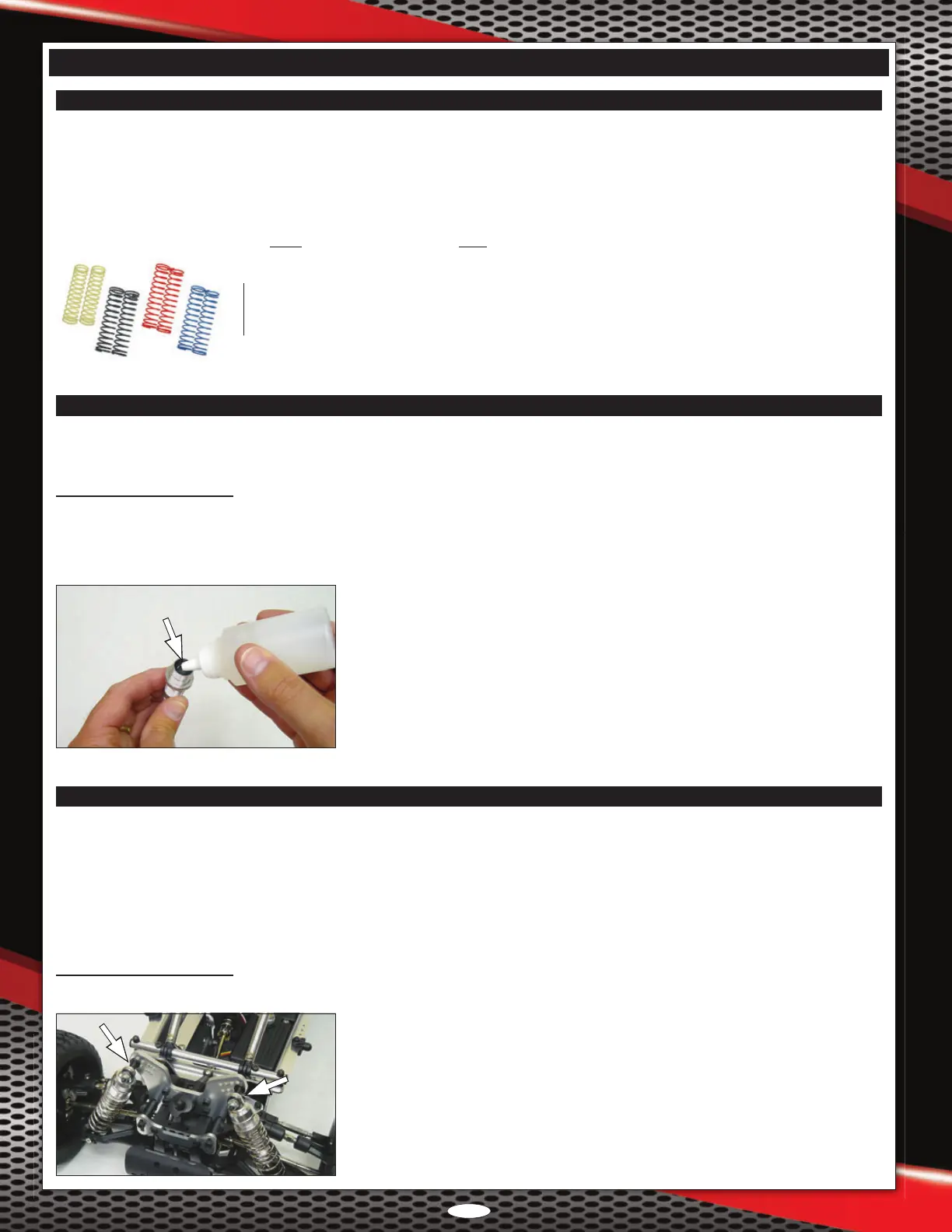
Shock springs are easy to change and can make a difference in the way your Rail handles relative to the type of terrain you're driving
on. If you drive your Rail off-road, in a smooth, high-traction area, use stiffer springs to reduce body roll and weight shift. If the area
where you drive your Rail is very bumpy, you might consider using softer springs to help absorb the bumps. If the area is bumpy and
you use harder springs, the Rail will have a tendency to jump and hop around. The shock springs included with the Rail are suitable
for most general off-road applications.
n
Changing Shock Springs - Front and Rear
P/N 149356 58mm and P/N 149372 80.5mm 1.3mm Shock Spring (RED)
P/N 149354 58mm and P/N 149370 80.5mm 1.4mm Shock Spring (BLUE)
P/N 149352 58mm and P/N 149366 80.5mm 1.5mm Shock Spring (WHITE)
P/N 148672 58mm and P/N 148673 80.5mm 1.6mm Shock Spring (SILVER) - STOCK
P/N 149349 58mm and P/N 149364 80.5mm 1.7mm Shock Spring (BLACK)
SOFT
STIFF
q Remove the 3mm lock nut that holds the top of the shock in place, the pull the top
of the shock (and the bushing) off the shock mount.
q Unscrew the shock mount, then reinstall it into the new desired position, making sure
to tighten the cap screw rmly.
q Reinstall the bushing and shock. Firmly tighten the 3mm lock nut, then loosen it 1/2 a
turn to ensure the shock doesn't bind. Make sure to adjust the right and left sides equally.
The Rail shock towers feature a number of different mounting positions for the shocks. By changing the location of the upper shock mounts
you can make the shock feel stiffer or softer as the Rail rolls from side-to-side. In general, moving the shocks toward the outside will
make the shock stiffer and moving the shock toward the inside will make the shock softer.
You will need to experiment with these settings to nd something that suits both your track and driving style. A good starting point is
to adjust the rear shocks. Moving the rear shocks toward the outside will give more 'bite' (traction) in the turns. However, depending on
how you drive, you might want to move the shocks toward the middle. This will give a more 'plush' suspension.
n
Adjusting Shock Mounting Positions - Front and Rear
l
We recommend initially leaving the shock mounting positions in the factory locations.
Changing the shock oil will change the damping characteristics of the shocks. Typically, if you are running on smooth surfaces, use a
heavier weight shock oil. If you are running on rough surfaces, use a lighter weight shock oil.
n
Adjusting Shock Damping - Front and Rear
l
We recommend using the shock oil that the shocks are already lled with. For racing, you may want to consider using 40 weight
shock oil. Use only 100% silicone oil in the shocks. Do not use motor oil.
q Remove the 3mm lock nut that holds the top of the shock in place, the pull the top of the shock (and the bushing) off the shock mount.
q Carefully unscrew the shock cap. Pull the shock piston down completely, then empty
the shock oil from the shock. Fill the shock body with shock oil until the oil level is just
below the top of the shock body, then pump the shock piston up and down several
times to dissipate any air bubbles from the shock oil. Top off the shock oil level if
necessary, before reinstalling the shock cap. For more information, see page 41.
q Reinstall the bushing and shock. Firmly tighten the 3mm lock nut, then loosen it 1/2 a
turn to ensure the shock doesn't bind. Make sure to adjust the right and left sides equally.




 To Next Page