Information on the use of different types of
electrodes
The electrodes must be selected and applied with care. During constant current operation,
ensure good, even contact with skin. A decrease in the area of contact can cause the patient
to have paraesthesias.
Prior to treatment, the skin should be inspected and cleaned, if necessary, for example if the
patient is sweaty or if ointments have been applied to the skin. Inflamed areas of skin, small
wounds or fissures are covered with Vaseline or zinc paste. Particular caution is also required
in the case of fresh scars.
The self-adhesive disposable electrode enables convenient, quick application. Their one-time
use ensures hygienic application. Three therapeutically useful sizes enable individual therapy
that is adapted to the patient's medical condition.
Disposable electrodes are particularly suitable for therapy with bipolar currents; for therapy
with monopolar pulse currents or currents with a galvanic component, a moist sponge should
additionally be used with the disposable electrodes as padding.
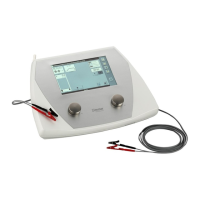
All conventional electrotherapy electrodes can be connected to the PhySys using an insulated
The disposable electrode is for one-time use only and can be disposed of with household
waste without any problems.
Use of the disposable electrode several times can be hazardous to the patient.
For applications over particularly large areas, plate and rubber electrodes are available, in
addition to the disposable electrodes.
The electrical connection is made using the clips of the electrode cable, just as in the case of
the disposable electrode. Secure clips to the plate electrode which is fully inserted into the
Rubber electrodes are suitable for therapy with bipolar currents; when using a purely galvanic
current, currents with galvanic components or a longer pulse length, it should be noted that
there is a decrease in conductivity through the withdrawal of carbon, which is the normal result
For therapy with a purely galvanic current (galvanisation, iontophoresis), large tin plate
electrodes are suitable.
sponges
Rubber and tin plate electrodes must always be padded with a moist intermediate layer. The
use of sponge pockets is recommended for rubber electrodes; sponges which should be at
least 1 to 2 cm thick are recommended for tin plate electrodes. Tap water is recommended for
moistening the sponges; distilled water is not suitable due to its poor conductivity.
In contrast to the convenient, self-adhesive disposable electrodes, rubber and tin plate
electrodes must be secured. Velcro or elastic straps are suitable for this purpose.
Insert the electrodes all the way into the sponge pockets and apply with gentle pressure until
they properly sit closely against the body. The securing straps should not leave behind any





 To Next Page