12.2.6 Operation principle
12.2.6.1 Current reversal logic
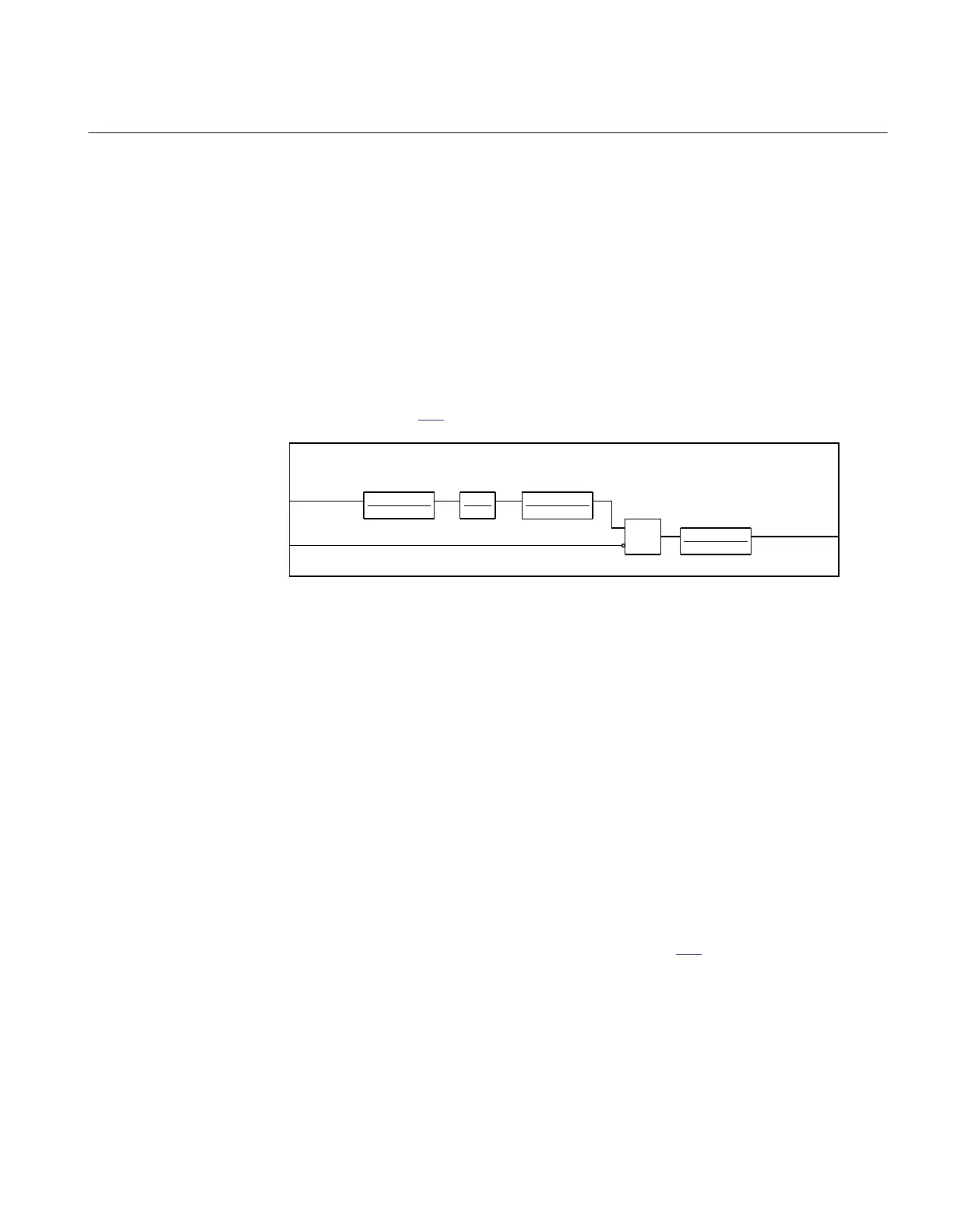
The current reversal logic can be enabled by setting the parameter CurrRev = On. The
current reversal logic uses a reverse zone connected to the input IRV to recognize the fault
on the parallel line in any of the phases.When the reverse zone has been activated (even
if only for a short time), it prevents sending of a communication signal and tripping
through the scheme communication logic after a settable time tPickUpRev. The
prevention will last for tPickUpRev + 10 ms + tDelayRev after the IREV reset. This makes
it possible for the receive signal to reset before the carrier-aided trip signal is activated due
to the current reversal by the forward directed zone. The logic diagram for current reversal
is shown in Figure 235.
ANSI05000122-2-en.vsd
IREV
IFWD
IRVL
AND
0
10ms
0-tPickUpRev
0
0-tDelayRev
0
0-tPickUpRev
0
ANSI05000122 V2 EN
Figure 235: Simplified logic diagram for current reversal
By connecting the output signal IRVL to input BLKCS in the ZCPSCH (85) function, the
sending of the signal CS from the overreaching zone connected to CSOR in ZCPSCH will
be blocked. By connecting IRVL to input BLKTR in the ZCPSCH function, the TRIP
output from the ZCPSCH (85) function will be blocked.
The function has an internal 10 ms drop-off timer which secure that the current reversal
logic will be activated for short input signals even if the pick-up timer is set to zero.
12.2.6.2 Weak-end infeed logic
The weak-end infeed logic (WEI) function sends back (echoes) the received signal under
the condition that no fault has been detected on the weak-end by different fault detection
elements (distance protection in forward and reverse direction).
The WEI function returns the received signal, see figure
236, when:
1MRK 506 335-UUS A Section 12
Scheme communication
505
Technical manual





 To Next Page