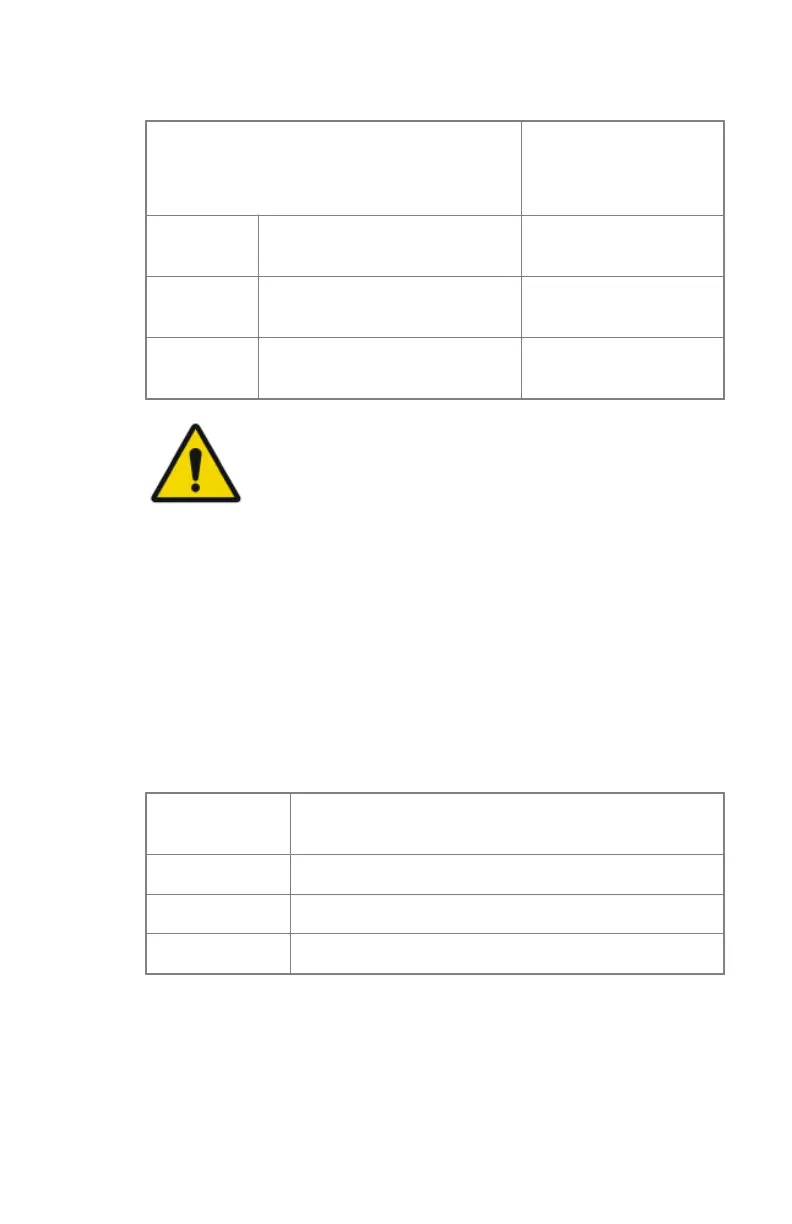
The displayed values (that have to be monitored) represent the following
steps on the test film:
Operating Level Value (Macbeth units)
(according IEC
1223-2-4 or better)
Low density the density value of the Low
density step
0.4 ± 0.05
Mid density the density value of the Mid
density step
1.2 ± 0.15
High density the density value of the High
density step
2.0 ± 0.20
WARNING:
If the mid density value does not meet or exceeds the
recommended values, the cause must be found and the
problem solved before any further clinical films can be
printed. If the problem cannot be solved, call your local
service organization.
5. Record the density levels on Chart 1 (‘Determination of Operating Levels’).
6. Press the Confirm key to return to the main menu.
7. Repeat steps 1 through 6 once a day for five consecutive days, as indicated
on the Chart 1.
8. Calculate the average value of the densities from the five images. These
values represent operating levels or aim values, for each density.
9. Record the respective aim (average) values as the ‘Operating levels’ on
Charts 2a and 2b (‘Daily Density Control Chart’).
The calculated ‘Operating levels’ should be as follows:
Operating Level
Value (Macbeth units) (according IEC 1223-2-4 or
better)
Low density 0.4 ± 0.05
Mid density 1.2 ± 0.15
High density 2.0 ± 0.20
10. These charts will be used for the daily quality test.
Related Links
Preventive maintenance schedule on page 111
Charts for general radiography QC on page 130
Performing the daily QC test for general radiography applications on page 95
Drystar 5500, Drystar 5503 | Advanced Operation (key-operator mode) | 91
2901J EN 20191018 0826






 To Next Page