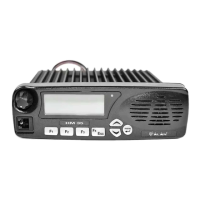
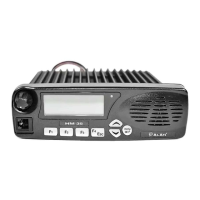
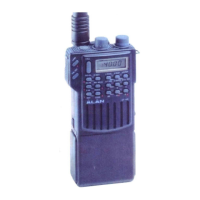
HP106 Service Manual
Page 4 of 12
2 CIRCUIT DESCRIPTION
2.1 General information
The HP-106 has three printed circuit boards. Circuitry is divided in the following sections:
Microprocessor/Control
VCO/Synthesizer
Transmitter
Receiver
Signalling
Battery
Refer to the Block Diagram and the Schematics.
2.2 Microprocessor/control
The microprocessor IQ9 is constantly operating when the radio is turned ON. It is continuously monitoring the
keyboard, the PTT line and other internal inputs such as the squelch detect, etc. When a change occurs, the
microprocessor makes the appropriate response. The microprocessor is used for control. The Radio emits a beep
on channel change and the synthesizer is loaded with the correct frequency information. The microprocessor runs
off a 8 MHz oscillator which is composed of IX1, IC30, IC31 and IR48.
When the radio is first turned on, the microprocessor reads the radio status from the EEPROM IQ8.
The microprocessor determines the receive frequency codes, then loads the synthesizer via its pins 42 (PLL LE),
46 (PLL CLK) and 43 (PLL DATA).
The microprocessor is fitted with an internal program flash memory as well, therefore functions can be
customised, if necessary, upon specific request from the customer.
2.3 VCO / Synthesizer (PLL)
This section consists of the Temperature-Compensated Crystal Oscillator (TCXO), Voltage Controlled
Oscillator(VCO), Synthesizer and the Loop Filter.
2.3.a Temperature-Compensated Crystal Oscillator (TCXO)
The reference oscillator (X401) is a temperature compensated crystal- oscillator, RV402 is used to adjust the
oscillator on frequency (14.4 MHz) at room temperature (22 ℃). The reference oscillator is held within the
specified ±2.5 PPM from -30 to +60℃.
2.3.b Voltage-Controlled Oscillators
Only one of the VCOs runs at a time, which is controlled by Q420 and IQ9. When the PTT is pressed, IQ9 pin 34
goes low (approx. 0V) disabling the receive VCO by the Q420 and biases on Q419 to enable the transmitter VCO.
The receive VCO consists of C482-C485, CV401, L426-L428, and Q422-Q424. This VCO oscillates at 45.1 MHz
above the programmed receive frequency. The VCO’s oscillating frequency is tuned by the varactors Q423 and
Q424. The tuning voltage is supplied from the output of the Loop Filter. The output of the VCO is AC coupled
(C475 and R558, C530, C505) to the synthesizer and the output buffer Q414 respectively.
The transmitter VCO consists of C487, C489-C491, CV402, L424, L425, L429 and Q416-Q418.
This VCO oscillates on the programmed transmit frequency. The VCO’s oscillating frequency is tuned by the
varactors Q417 and Q418. The tuning voltage is supplied from the output of the Loop Filter. The output of the
VCO is AC coupled (C486) to the synthesizer input buffer Q428 and the output buffer Q415 respectively.
The transmit voltage controlled oscillator is directly frequency-modulated and operates on the carrier frequency. In
the receive mode, the transmit VCO is disabled and the receive VCO is enabled, producing the receive local
oscillator signal at a frequency 45.1 MHz below the incoming receive frequency.


 To Next Page