HP106/HP406 Programmer software guide
Ver. 1.0 Page 13
5 SELECTIVE CALL SETUP
You can define two separate databases for selective calls: one is for TX and the other for RX. Each database can store up to
15 tone sequences, each of them can be programmed up to 20 tones. HP106 can be programmed in order to:
RX - decode up to two RX sequences (Seq. I and Seq. II) per RF channel.
TX - transmit up to four TX sequences per RF channel, to be set as Call1 and Call2, Emergency and ANI as you will see later on. The
first two sequences are transmitted by keeping pressed
, respectively, the MON or FUNC keys as stated in the user’s manual. Moreover,
if both keys are kept pressed together, the emergency call is transmitted in the currently tuned channel or in a preset one
For further details about setting Call1, Call2, Emergency and ANI calls please see the par. 5.4
5.1 Defining Selcal RX parameters
1) From the Channel Data window, press Global Data button: the Global Data window will open.
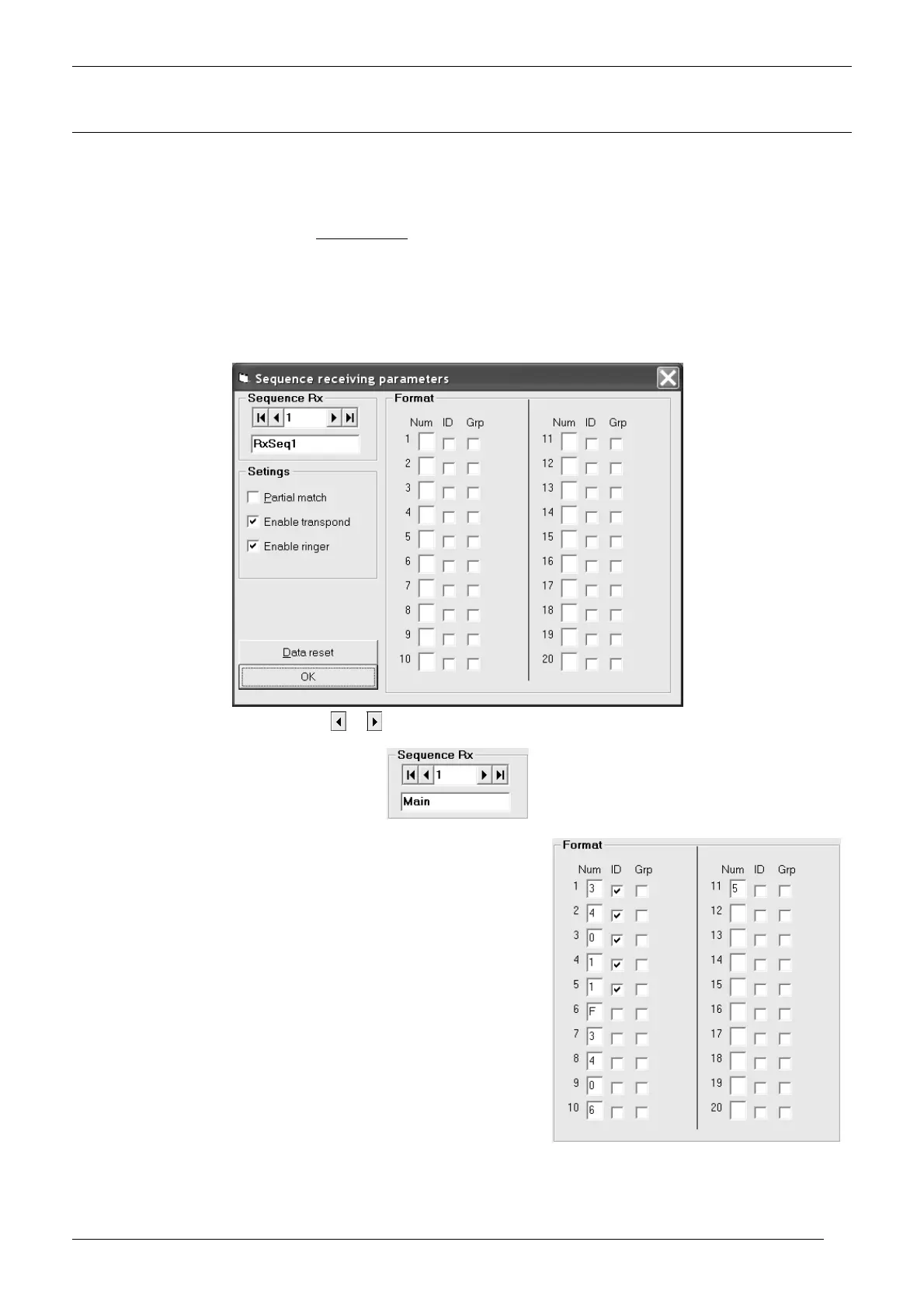
2) From the area Tables press RX tone sequences button: the Sequence receiving parameters window will open.
3) Go to Sequence Rx area and press the
or button to select the Rx sequence you need to setup. In the following example we
selected the sequence 1.
4) If you want to assign an alphanumeric name to the selected Rx sequence, just type the new name over the existing one RxSeq.x (in the
example we renamed the sequence 1 as Main).
5) Now you have 20 decode events (from box 1 to box 20) available, in which of
them you can define the decoded tone. Type the related numbers (or letters) in
each box and then enable the identification ID of the required tones by checking
the related checkbox.
In the example we typed the format 3 4 0 1 1 F(pause tone) 3 4 0 6 5, however
we enabled the ID of the first five tones only by ticking only the related check
boxes. We’ll explain later the meaning of this operation.
6) If you like, you can add some additional capability to each event by checking the
related boxes:
ID means Identification. It is useful to recognize a selective call even if it
doesn’t completely match with the programmed sequence. Please have a look
to Partial Match at the next step.
Grp is the group checkbox, which allow you to define the related tone as a
group one.
Obviously, GRP checkbox should be ticked only after the last ID digits, because
there is no reason to define the first tones to be decoded as group ones.


 To Next Page