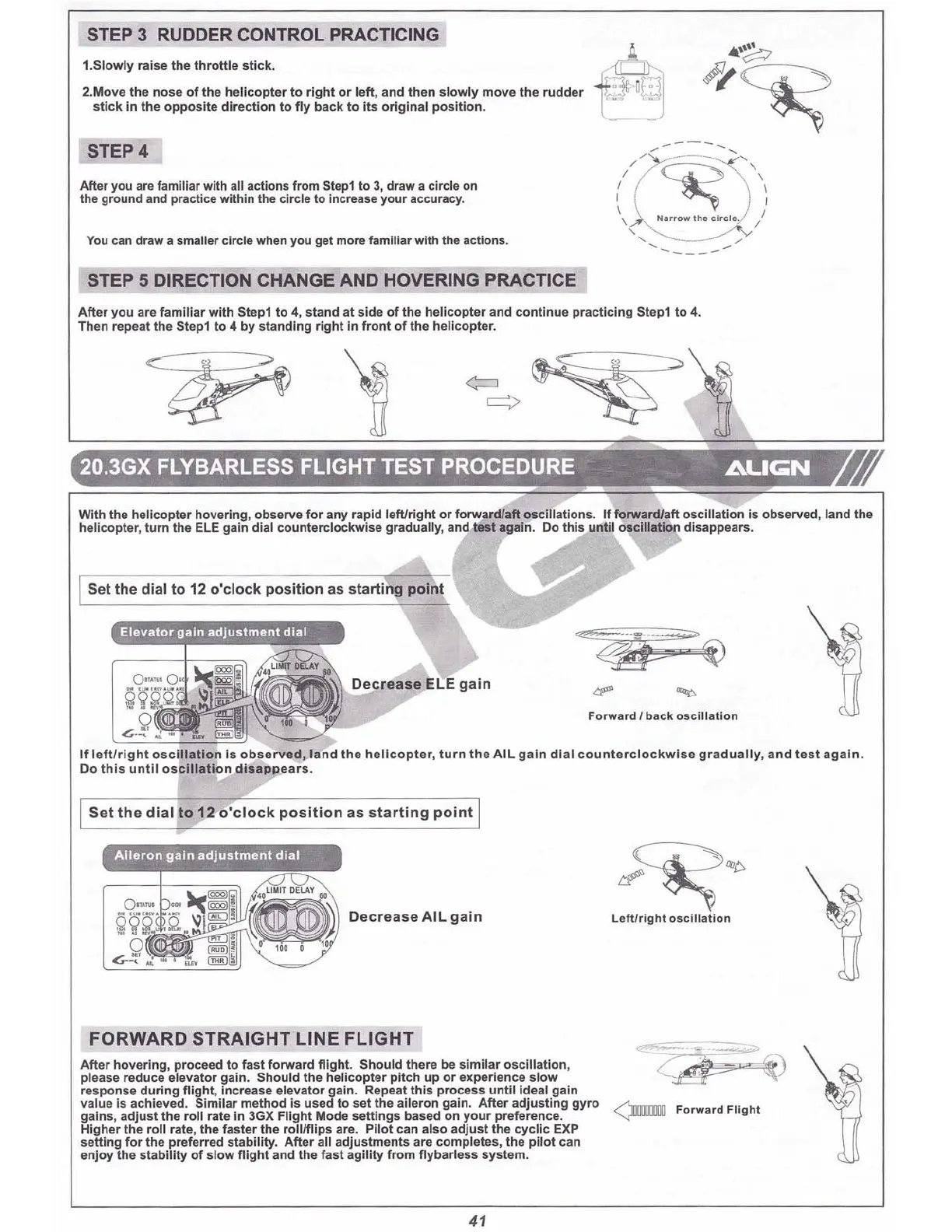
STEP 3 RUDDER CONTROL PRACTICING
1.Sto
wl
y raise the thro
tt
le
st
ick.
2.Move
the
no
se of the h
elic
opt
er to ri
ght
or
l
eft
, and th en s
low
ly move the r
ud
der
sti ck In
the
op
pos
ite
dire
ct i
on
to fl y back to i
ts
o
rig
inal position .
After you are familiar with all actions fro m Step1 to 3, draw a
cir
cle on
the ground and practice within the circle to Increase your acc uracy.
You can draw a smaller eirele when you get more familiar
wit
h the actions.
STEP 5 DIRECTION CHANGE AND HOVERING PRACTICE
After you are familiar with Step1 to 4, stand at s ide of the helicopter and continue practicing
Ste
p1 to 4.
Th en
repeat
the Step1 to 4 by
sta
nding ri ght In fr ont
of
the
helico
pter
.
20.3GX FLYBARLESS FLIGHT TEST PROCEDURE
L\LI~N
With
the
helicop
ter
hove
rin
g, observe
fo
r any rapid left/
righ
t or fo rwa
rdf
aft
oscill
ations. If forwa rd/aft
osc
illat
ion is observed, land th e
helicopter, tu m the ELE gain dial coun
ter
cloc
kwise
gr
adu
all
y, and
tes
t again. Do th is un
til
osc
illa
tion dis appears .
Set the dial to 12 o'cl
ock
pos
iti
on as
start
ing
point
Elevator
gain
adjustment
dial
F
orw
ar
d I
back
o
sci
llation
If l e
ft/r
ig ht
osc
illa
tio
n Is o
bse
rv
ed
,l
and
th
e h
eli
c
op
ter, t
urn
t he AIL g ai n
di
al
co
u n
te
rc
lockwise
gr
adu
all
y, and te
st
a
ga
in.
00
t
his
until
osc
il
l
atio
n
disap
!J
ear
s.
S
et
th e
dial
to
12
o'clock
po
sit
ion
as s
tar
tin
g
po
i
nt
D
ecr
ease
AIL
gai
n
~
~~
Le
ft/r
ight
oscillat
ion
FORWARD
STRAIGHT
LINE
FLIGHT
After
hov
erin
g, proceed to fast
fo
rwa rd fl igh t.
Should
the
re be si
mila
r o
sc
illati
on
,
please red
uce
elevato r gain. Shou ld the helic
op
ter
pitch
up
or
expe
rience s
low
respo
nse
durin
g
fli
ght
, increase elevator gain. Repeat this pr ocess
until
Ideal gai n
value
Is ac
hieved
. Simila r meth od Is used to set the aileron
gai
n. Aft er ad
justi
ng
gyro
gains, adj ust th e roll rate In 3GX Flig
ht
Mode
setti
ngs
based on your pr eference.
Higher the r
oll
rate, the fa s
ter
the
rolllfl
ips are.
Pilot
can al
so
a
dju
st th e c
yclic
EXP
sett
ing for the pre
ferred
sta bility. After all adj ustments are com
plet
es, the
pilot
can
e
njoy
the sta b
ility
of
s
low
fli
ght and th e fast agil
ity
fr om
f1
yb
arl
ess
sys
tem.
41
<)mum
Forward Fli ght



 To Next Page