SECTION 1 GENERAL
1-18
Model MS2668C
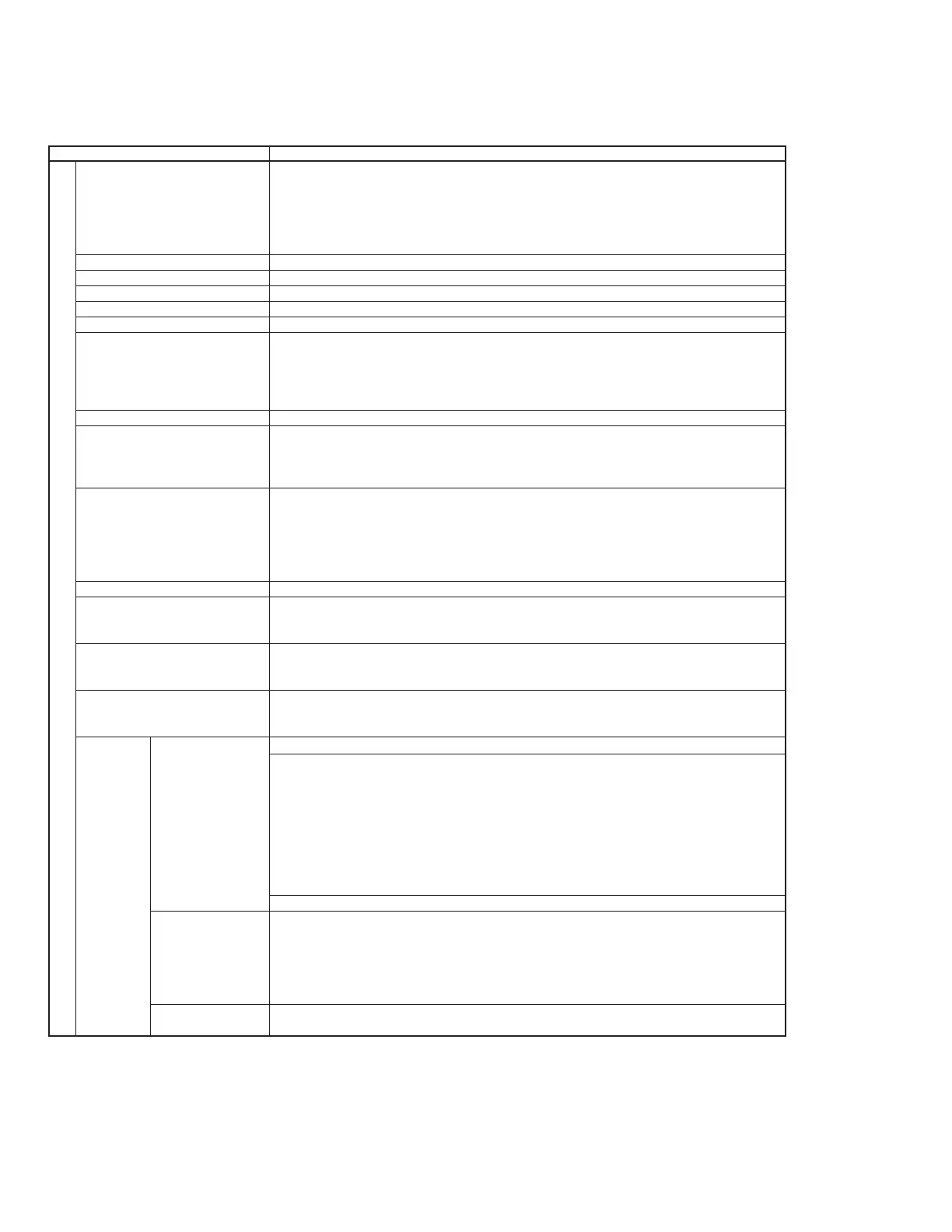
FM demodulation waveform display
Setting range: 2, 5, 10, 20, 50, 100, 200kHz/div
Accuracy: ±5% of full scale
(referenced to center frequency after calibration, DC-coupled, RBW 3MHz, VBW 1Hz, CW)
Frequency response (3dB): DC (50Hz at AC coupled) to 100kHz (range ≤20kHz/div, VBW off), DC (50Hz
at AC coupled) to 500kHz (range≥50kHz/div, VBW off)
*Useable RBW: ≥1kHz
Signal search AUTO TUNE, PEAK→CF, PEAK→REF, SCROLL
Zone marker NORMAL, DELTA
Marker MARKER→CF, MARKER→REF, MARKER→CF STEP SIZE, ∆MARKER→SPAN, ZONE→SPAN
Peak search PEAK, NEXT PEAK, NEXT RIGHT PEAK, NEXT LEFT PEAK, MIN DIP, NEXT DIP
Multi-marker Numbers of markers: 10 max. (HIGHEST 10, HARMONICS, MANUAL SET)
Measure
Noise power (dBm/Hz, dBm/ch), C/N (dBc/Hz, dBc/ch), occupied bandwidth (power N% method, X-dB
down method), adjacent channel leakage power (REF: total power method, REF: reference level method,
REF: inband method, channel designate display: 2 channels × 2, graphic diplay), average power of burst
signal (average power in designate time range of time domain waveform), template comparison (upper/lower
limits × each 2, time domain), MASK (upper/lower limits × each 2, frequency domain)
Save/recall Save and recall setting conditions and waveform data to internal memory (max.12) or memory card
Printer (HP dotmatrix, EPSON dotmatrix or compatible model):
Hard copy
Display data can be hard-copied via the RS232C, GPIB, or Centoronics (Option10) interface
Plotter (HP-GL, GP-GL compatible models):
Display data can be hard-copied via the RS232C or GPIB interface
Language: PTL (interpreter based on BASIC)
Progamming:Using editor of external computer
PTA
Progamming memory: Memory card, upload/download to/from external computer
Progamming capacity: 192kbyte
Data processing: Directly accesses measurement data according to sysytem variables, system subroutines,
and system functions
RS-232C Output data to printer or plotter. Control from external computer (excluding power switch)
GPIB interface
Functions: Meets IEEE488.2, Can be controlled as device from external controller (excluding power switch),
or can control external equipment as controller
Interface functions: SH1, AH1, T6, L4, SR1, RL1, PP0, DC1, DT1, C1, C2, C3, C4, C28
Memory card interface
Functions: Save/recall measurement settings and data,uploads/downloads PTA programs, access SRAM,
EPROM and flash EEPROM (can write to SRAM only), Supports cards up to 2MB
Connector: PCMCIA Rel.2.0 2 slots
Autocorrection ofMA1621A impedance transformer insertion loss
Correction Correction accuracy(input attenuator: (10dB):
±2.5dB (9 to 100kHz), ±1.5dB (100kHz to 2GHz), ±2.0dB*1 (2 to 3GHz)
Frequency Frequency Range: 18GHz to 110GHz
Frequency band configuration
Band Frequency harmonic order of mixer
K 18 to 26.5GHz 4
A 26.5 to 40GHz 6
Q 33 to 50GHz 8
U 40 to 60GHz 9
V 50 to 75GHz 11
E 60 to 90GHz 13
External
W 75 to 110GHz 16
mixers
Span setting range: 0Hz, 100 × N Hz to each bandwidth *N: harmonic order of mixer
Amplitude Level measurement
Mixer conversion loss setting range: 15 to 85dB
Maximum input level: Depends on the external mixer used
Average noise level: Depends on the external mixer used
Reference level setting range: –100dBm to (–25 + M) dBm (Log scale, *M: mixer conversion loss)
Frequency response: Depends on the external mixer used
Input/output terminal Suitable mixer: 2-port mixer only (Local frequency: 4 to 7GHz, IF frequency: 689.31MHz)
Display gain: 0 (2dB (External mixer input level –10dBm, when mixer conversion loss is 15dB)
(Continued)
Functions






 To Next Page