5.4.2. Filter Envelope
Across the bottom row are controls for an envelope dedicated to modulating the Filter
cutoff frequency. Think of an envelope as an extra hand on the Cutoff knob, giving some
movement and personality to the signal each time you play a note.
• Attack: Adjusts the time it takes for the cutoff to reach the value set on the Cutoff
knob.
• Decay: Adjusts the time it takes for the cutoff to change from the peak attack
level to the Sustain level.
• Sustain: Sets the level at which the filter sustains after the Decay phase, which is
for as long as a note is held.
• Release: Adjusts the time it takes for the cutoff to fall from the Sustain level to
zero once a note is released.
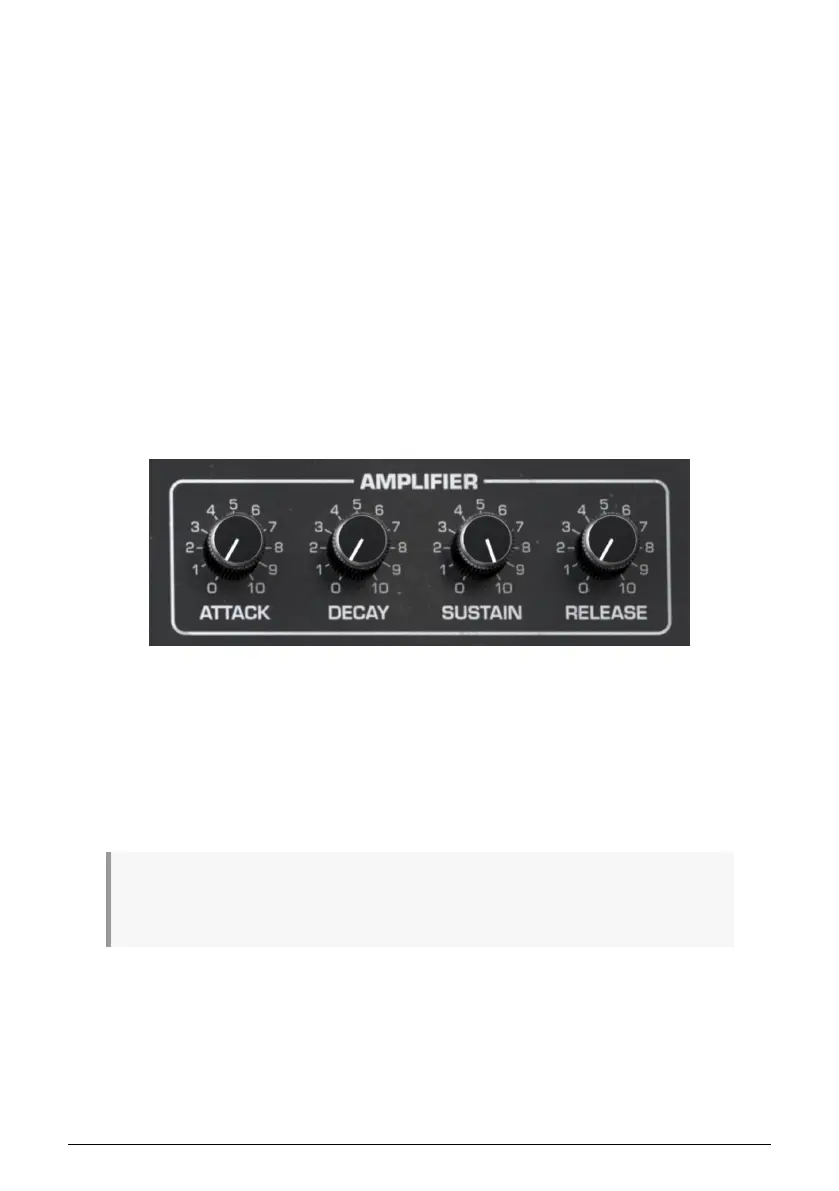
5.5. Amplifier Envelope
Volume (also called amplitude) can also be manipulated by an “extra hand.” In the analog
world, this is done with an envelope generator modulating a VCA, or voltage-controlled
amplifier.
• Attack: Adjusts the time it takes for the volume to reach the maximum value (in
other words, the upper limit determined by the Master Volume Knob).
• Decay: Adjusts the time it takes for the volume to change from maximum to the
Sustain level.
• Sustain: Sets the level at which the volume sustains after the Decay phase, which
is for as long as a note is held.
• Release: Adjusts the time it takes for the volume to fall from the Sustain level to
zero once a note is released.
♪ Our ears and brains identify sounds by the initial phase of their volume envelopes more than
any other factor. For example, increasing the attack time on a simulated piano sound usually causes
listeners to identify it as a violin or cello.
47 Arturia - User Manual Prophet-5 V - Main Synth Panel



 To Next Page