Need help?
Do you have a question about the AVMATRIX Shark S6 and is the answer not in the manual?
Essential safety warnings and precautions for operating the unit safely.
Recommendations for selecting an optimal and safe location for the video switcher.
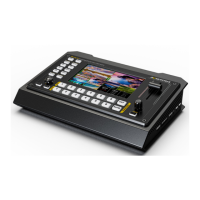
A general introduction to the Shark S6 video switcher and its capabilities.
Highlights the key functionalities and specifications of the Shark S6 switcher.
Detailed description of the physical input and output ports on the switcher.
Explains the pinout and function of the tally connector.
Lists all video and audio input/output connections and their specifications.
Summarizes the main operational functions of the video switcher.
Details the video and audio standards supported by the switcher.
Covers power, dimensions, and weight of the unit.
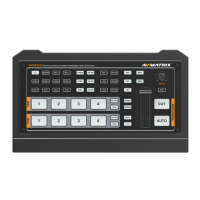
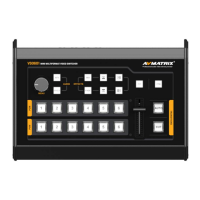
Identifies and explains the function of each button and control on the front panel.
Details the operating and storage temperature ranges for the unit.
Describes how to monitor multiple video sources on the built-in LCD.
Explains how to access and navigate the switcher's menu system on the LCD screen.
How to select Program (PGM) and Preview (PVW) sources from the front panel buttons.
Explains the three main transition control types: CUT, AUTO, and T-BAR.
Details on applying and customizing the WIPE transition effect.
Instructions for applying and customizing the DIP transition effect.
Explains the visual effects technique of Chroma Key for background removal.
Details on fine-tuning Chroma Key effects like similarity, smoothness, and opacity.
How to use Picture-in-Picture (PIP) and Picture-Out-Picture (POP) effects.
Detailed settings for PIP and POP effects, including border and position.
Explains the TIE option for DSK to synchronize with AUTO or T-BAR transitions.
Configuration options for Downstream Key, including source, clip, gain, and masking.
How to import and apply logos as overlays using the DSK function.
Describes the landscape and portrait layout options for the multiview display.
How to monitor audio levels for each source using the audio meters.
Shows resolution and frame rate for input signals on the multiview.
How to configure User Message Display (UMD) labels and opacity for inputs.
Details the physical video output ports available on the switcher.
Describes the PGM output ports (SDI and HDMI).
Details the HDMI Multiview output port.
Explains the functionality and configuration of AUX outputs.
How to use the USB-C port for video capture and streaming.
How to configure output formats like AUX, color space, brightness, and contrast.
Settings for output resolution and frame rate modes (Integer/Decimal).
Available options for output color space (YUV, RGB Full, RGB Limited).
Adjusting brightness, contrast, and saturation for the output image.
How to use the FTB feature for emergency blackouts and its speed adjustment.
How to freeze input sources using the STILL function.
Managing the main audio output for the PGM.
Setting volume levels for each audio input and master output.
How to mix multiple audio sources into the PGM output.
Configuring audio to follow the selected video source.
Adjusting audio delay for synchronization with video.
Settings for the two microphone inputs, including volume and delay.
How to configure the earphone output for audio monitoring.
Setting up live streaming via USB or Ethernet, including bitrate and protocols.
Detailed steps for configuring push streaming to platforms like YouTube.
How to set up local pull streaming using players like OBS or VLC.
How to record video to USB disk or SD card, including format options.
How to format USB disks and SD cards for recording.
Enabling or disabling the overwrite function for storage when full.
Connecting and controlling PTZ cameras via LAN or serial port.
Ways to call and connect PTZ cameras using Follow PGM, Follow PVW, or Camera ID.
Setting the interface language and adjusting cooling fan speed.
Calibrating the joystick and restoring device settings to defaults.
Manual time setting and viewing software/hardware version details.
Synchronizing the device time automatically or manually via LAN.
Configuring dynamic (DHCP) or static IP addresses for the switcher.
Assigning functions to shortcut keys for quick access.
Creating, renaming, switching, importing, and exporting user accounts.
Instructions for accessing the switcher's web interface for configuration.
Overview of the device status screen in the web interface.
Description of the control panel section in the web interface.
Managing audio settings through the web interface.
Configuring video and audio encoding parameters via the web interface.
Setting up and managing streaming configurations via the web interface.
Configuring recording parameters and managing storage through the web interface.
Accessing and managing system configurations via the web interface.

 To Next Page
 General