10-42
BSWSV
). Of these 4 options,
DPSV
and
OSWSV
are most often used, due to their
good sensitivity and low detection limits, together with their speed of operation. A
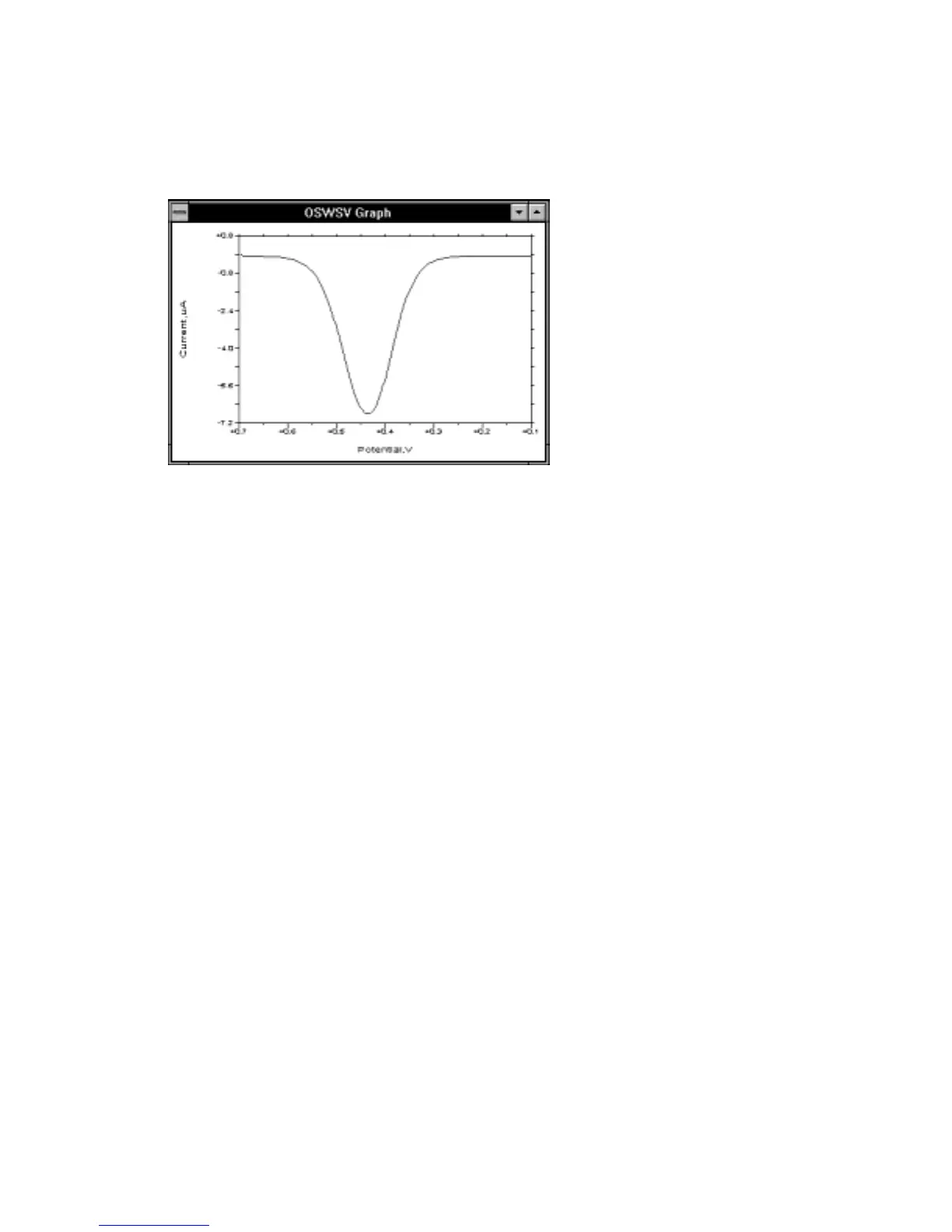
typical current response for the stripping step for
OSWSV
is shown in Figure 10-27.
Figure 10-27.
Typical current response for
OSWSV
.
It is important to note that it is the concentration of lead in the mercury electrode that
is important rather than the concentration of lead in solution. The concentration of
lead in the mercury electrode can be increased (and hence the detection limit of the
experiment lowered) by increasing the
Deposit Time
and/or the stirring rate. The
magnitude of these two parameters depends on the sensitivity of the mercury
electrode, which depends on the surface area to volume ratio (i.e., how many of the
lead atoms deposited are on the surface and detectable in the stripping step). This
ratio is considerably higher for the TMFE, so a shorter deposition time is required
(ca. 1-2 minutes vs. 5 minutes). In addition, faster stirring can be used with the TMFE
due to the relative mechanical instability of the HMDE. The signal resolution is also
better with the TMFE, which can be important when there is more than one metal ion
present.
However, the greater sensitivity of the TMFE can also be a disadvantage, since the
solubility of the metal in the mercury can be exceeded more readily. This can lead to
the formation of intermetallic compounds, which can affect the accuracy of the
experimental results (e.g., shifts in the stripping potential and depression of the
stripping current). One pair of metals that readily combine is zinc and copper.
In order to be of use as a quantitative analytical technique, the results of stripping
experiments must be reproducible. Therefore, experimental conditions must be
reproducible. Great care must be taken in the sample preparation, cleaning of
glassware, etc. The rate of stirring during the deposition step and the condition of the
mercury electrode must also remain constant. The advantage of using the Rotating
Disk Electrode with a TFME is the precise control of the rotation rate; however, it is
easier to obtain a reproducible electrode surface with the HMDE than with the TMFE



 To Next Page