10-34
10.5
A.C. Techniques (ACV/P, PSACV/P,
SHACP/V, TACV/P, DTACV/P)
Sinusoidal A.C. Techniques (ACV/P, PSACV/P, SHACV/P)
There are essentially two categories of sinusoidal A.C. techniques. In A.C.
Impedance, the D.C. potential is held constant (e.g., at the redox potential) and a
small amplitude A.C. potential is applied. This is discussed in more detail in section
10.9.4.
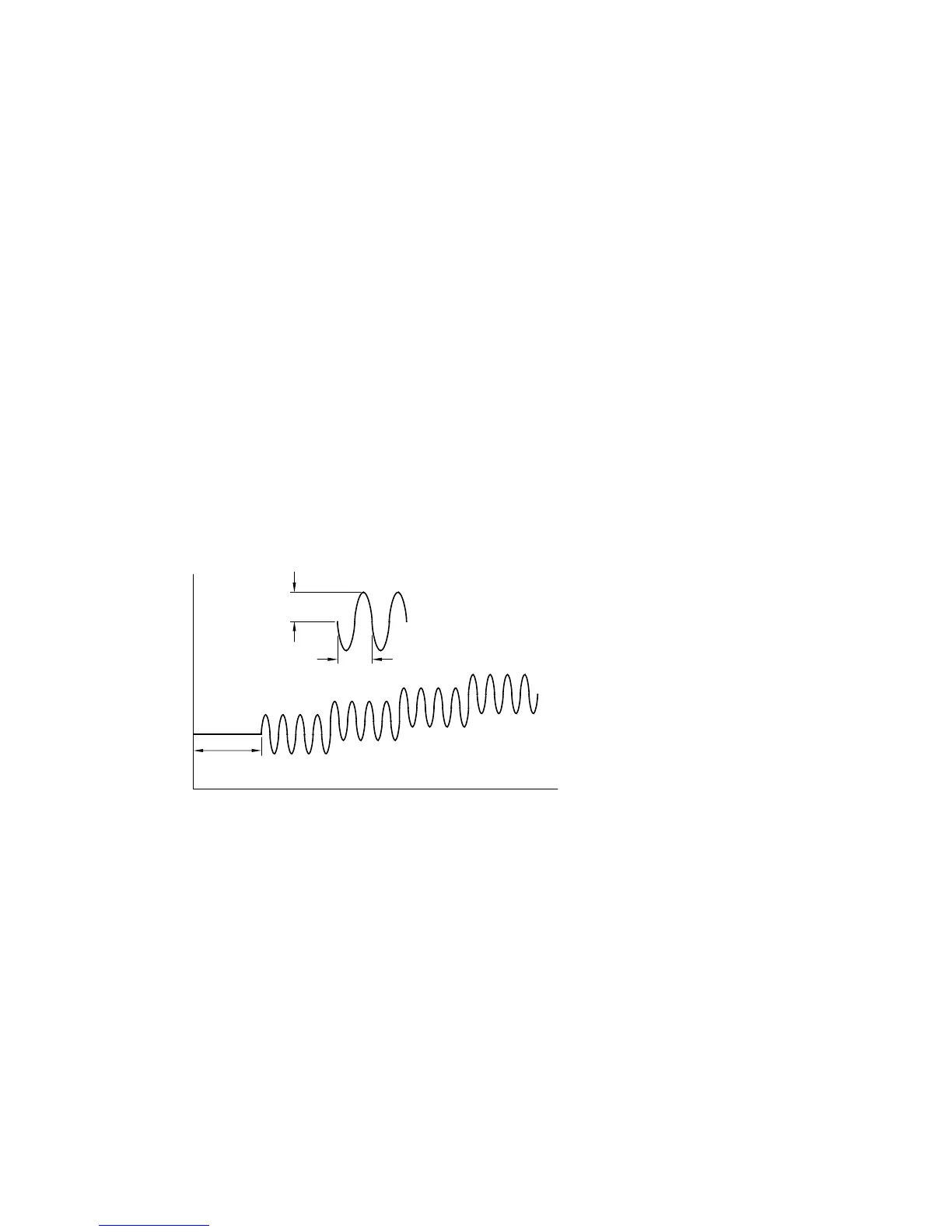
A.C. Voltammetric methods are a variation on A.C. Impedance. The frequency is
constant, and the D.C. potential is varied slowly (Figure 10-20). The D.C. potential is
used to alter the concentrations of the oxidized and reduced species at the surface of
the working electrode, and the A.C. potential is used to perturb these concentrations.
The A.C. potential will have the greatest effect at the redox potential, so the A.C.
current response for
ACV/P
is a peak-shaped curve (Figure 10-21).
E
QUIET
TIME
A.C. AMPLITUDE
PERIOD
t
Figure 10-20.
Potential wave form for
ACV/P
,
PSACV/P
and
SHACV/P
.
Due to the pseudo-capacitive behavior of the interfacial region, there is a phase
difference between the applied A.C. potential and A.C. current response. It is often
instructive to measure the A.C. current output at different phase angles, which can be
done with the
PSACV/P
techniques (Phase Selective). For an ideal system, the in-
phase A.C. current phase angle = 0
o
) should not contain any contribution from
capacitive currents; that is, this a method for discrimination between faradaic and
charging currents. However, in real systems, there is a small contribution (due to
phase shifts brought about by the solution resistance).



 To Next Page