10-13
10.2
Potential Step Techniques (CA, CC,
STEP)
In these techniques, the potential is stepped from one value to another, and the current
(
CA
) (or charge (
CC
)) response is monitored as a function of time (it should be
remembered that charge is simply the integral of current). After the potential has been
held at this value for a time
τ
, the potential can be stepped to another value (often the
original potential). Therefore, potential step experiments can be single step, or double
step.
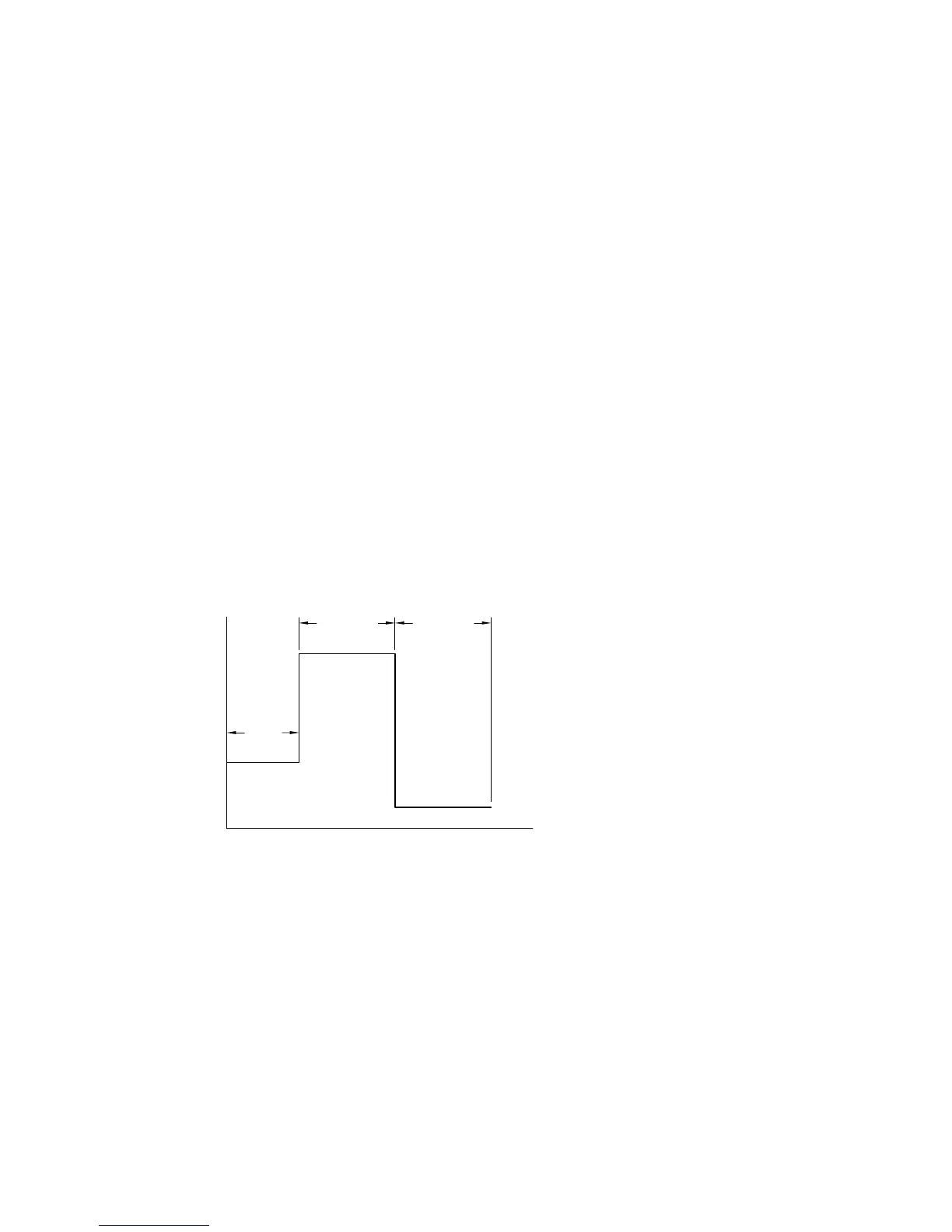
The
General Parameters
are slightly different for
CA
and
CC
. For
CA
, an initial
potential (
Initial E
), and high and low potentials (
High E
and
Low E
) are required.
The potential can be stepped from
Initial E
to either
Low E
or
High E
(this is
determined by the
Initial Direction
-
Positive
or
Negative
respectively). After time
τ
(the
Pulse Width
), the potential can be stepped in the opposite direction (from
Low
E
to
High E
or
High E
to
Low E
), and is held at this value for time
τ
(Figure 10-4).
For
CC
, the only potentials are the initial potential (
Initial E
) and the final potential
(
Final E
) (Figure 10-5).
E
PULSE
WIDTH
HIGH E
INIT. E
t
PULSE
WIDTH
QUIET
TIME
LOW E
Figure 10-4.
Potential wave form for
CA
.
The current/charge response depends on the values of the initial and final potentials.
If no faradaic reaction occurs at either potential (a faradaic reaction is the electrolysis
of any molecules in solution), then the response is due to charging of the electrode
(the charging or background current). The response is a current 'spike', which decays
exponentially.



 To Next Page