10-55
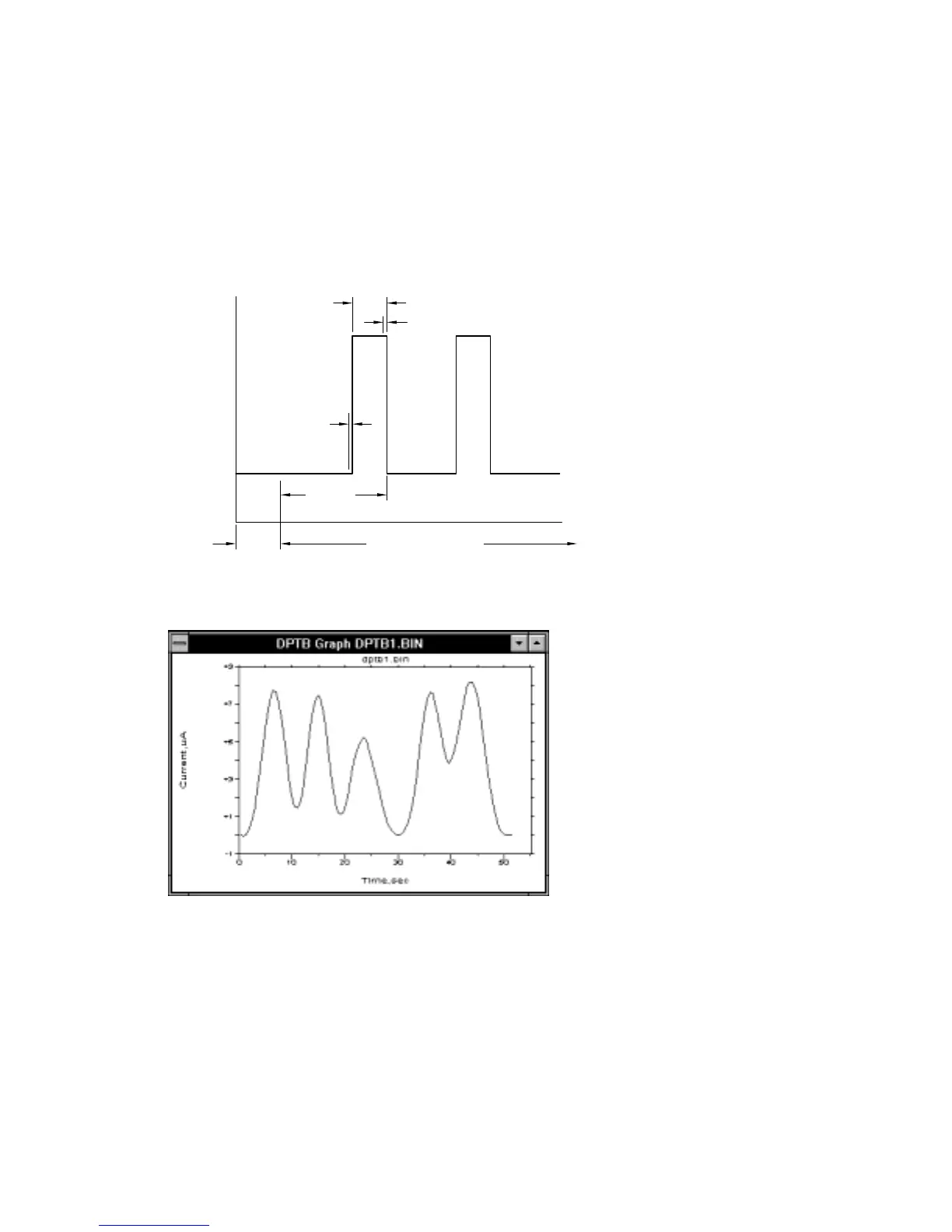
One modification of the TB potential wave form is to superimpose a sequence of
pulses of constant amplitude (Figure 10-36). This is the Differential Pulse (
DPTB
)
technique. As the current is sampled just before the pulse and at the end of the pulse,
there is effective discrimination against the background current. As it is the current
difference that is displayed, the technique allows examination of a defined potential
window, which enhances the selectivity of the detection. A typical current response
for DPTB is shown in Figure 10-37).
E
SAMPLE WIDTH I (FINAL)
PULSE WIDTH
FINAL E
INIT. E
PULSE
PERIOD
t
SAMPLE
WIDTH
I (INIT)
SAMPLING TIME
(MAX = 8000 x PULSE PERIOD)
QUIET
TIME
Figure 10-36.
Potential wave form for
DPTB
.
Figure 10-37.
Typical current response for
DPTB
.
Detection of reducing sugars, primary amines and thiols using a simple amperometric
experiment requires a high potential, which reduces the sensitivity and selectivity.
The Triple Pulse potential wave form (
TPTB
) is especially suited for these
molecules. As the name suggest, three potential pulses are sequentially applied, and
the current is sampled at the end of each pulse (Figure 10-38). This wave form is
repeated for the required number of cycles and one of the current samples is
presented as a function of time (Figure 10-39) (the other two are stored and can be



 To Next Page