5-4
Measurement of Uncompensated Resistance
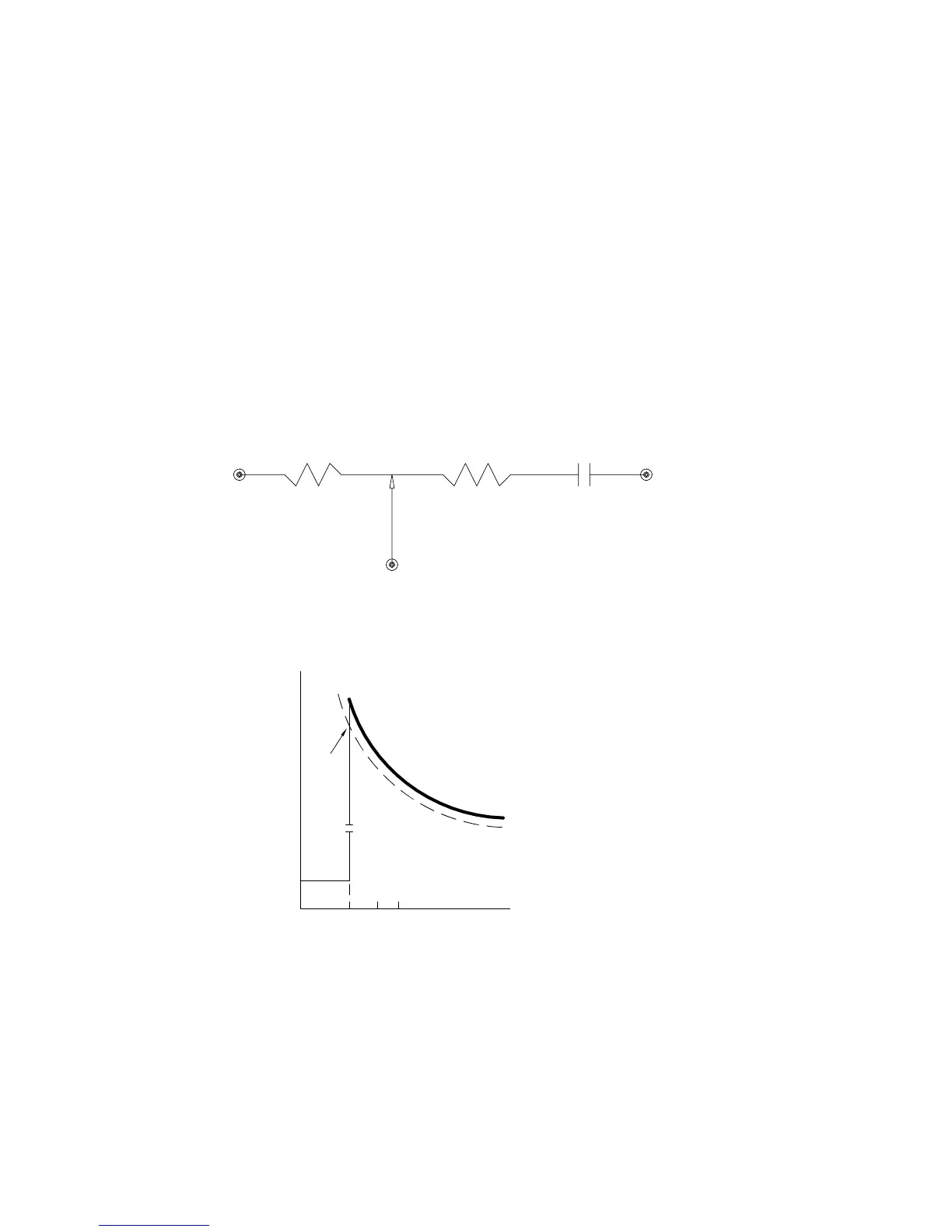
In this measurement, the electrochemical cell is considered to be electronically
equivalent to an RC circuit; that is, the uncompensated resistance (R
u
) is in series
with the double-layer capacitance (C
dl
) (Figure 5-2). Since a Faradaic impedance
is not considered as part of this model, the test potential (Test E) must be at a
value at which no Faradaic process occurs. A 50 mV potential step (∆E) is applied
around this potential (i.e., Test E-25 mV to Test E+25 mV), and the current is
sampled at 54 µs and 72 µs after the step is applied. The current decays
exponentially, and the initial current (I
o
) is calculated by extrapolating back to
zero time (Figure 5-3). Since ∆E = I
o
R
u
, R
u
can be calculated from this
measurement. To reduce any error, this measurement is performed 256 times, and
the results averaged.
R
R
R
C
A
W
c
u
dl
Figure 5-2.
RC circuit used for calculation of the solution resistance.
i
i e
-t/R C
u dl
o
0 54 72
t/
µ
s
Figure 5-3.
Exponential decay of current response.



 To Next Page