My BERNINA
57
BERNINA SEWING MACHINE WORKBOOK
Presser Foot
The Presser Foot you select is critical for good results
because it can affect the way the fabric feeds under
the needle, inuencing the stitch formation.
Usually the key to selecting the correct Presser Foot is
the sole.
Stitches that are more open and have less thread will
stitch well with an all-purpose or zigzag Presser Foot.
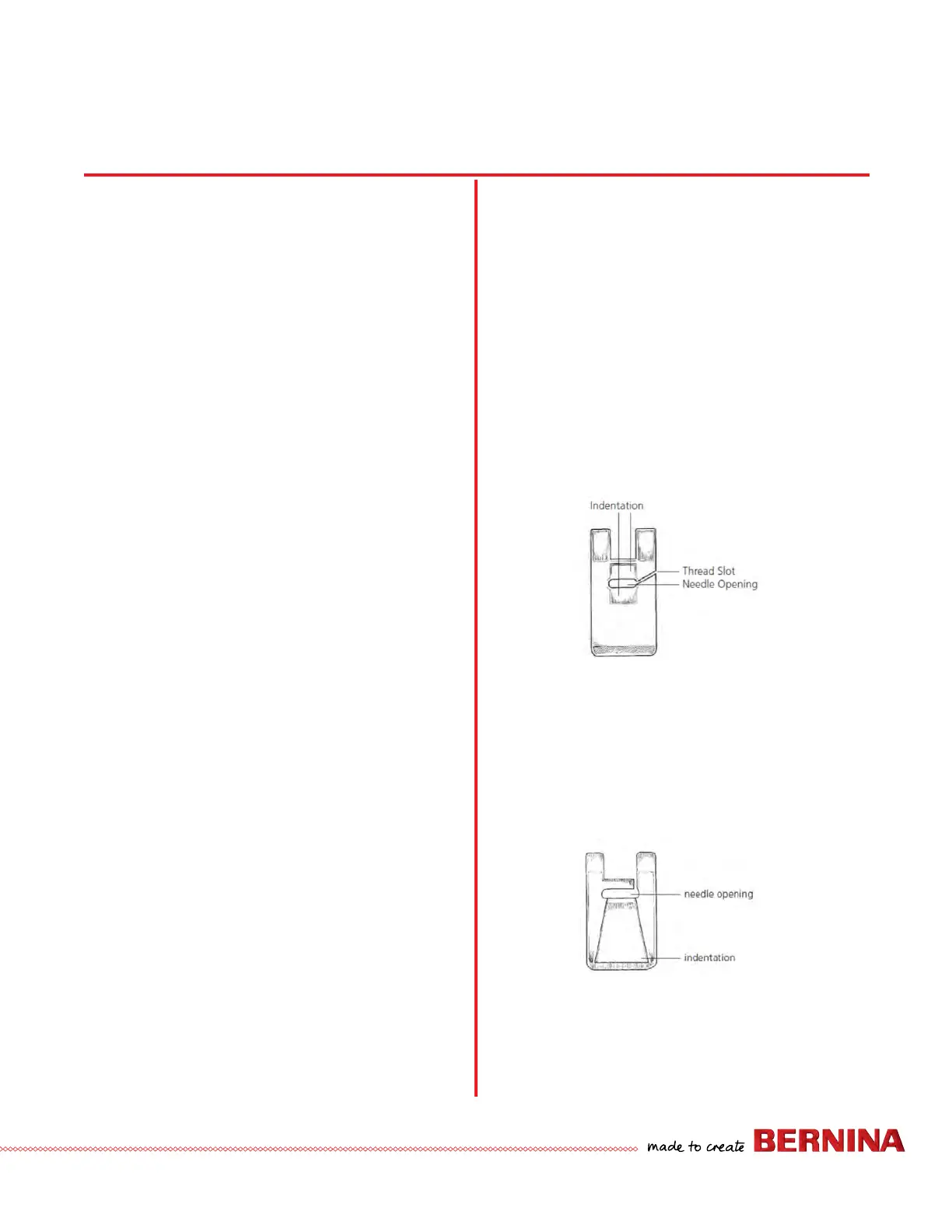
• Reverse Pattern Foot #1/1C/1D has small indenta-
tions in front of and behind the needle that allow
the fabric to move in a “back and forth” manner
when forming the stitches.
If you are creating heavy, satin stitched patterns,
you will need a foot that is not at on the bottom. It
should have some type of indentation that allows the
foot to ride over the completed stitch without drag-
ging or inhibiting the feed of the fabric.
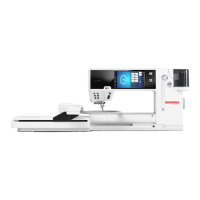
• Embroidery Foot #6 has a wedge-shaped indenta-
tion behind the needle, perfect for allowing heavy
compact stitches to ow freely from under the back
of the Presser Foot.
• Open Embroidery Foot #20/20C/20D and Clear
Embroidery Foot #39/39C/39D both have the same
shape but the Clear Embroidery Foot offers more
visibility of the stitching area.
As you being to experiment with decorative stitches
on your BERNINA machine, there are several things
you should keep in mind:
• Type of thread you plan to use
• Presser Foot you select
• How you prepare your fabric
Type of Thread
Selecting the thread for decorative stitching often
comes down to a personal preference and what looks
best on your project.
Cotton embroidery thread, especially in a heavier
weight such as 30, gives a beautiful look to the
stitches and has a nice luster to it.
If you want a high sheen, rayon or polyester embroi-
dery thread are good choices.
Preparing the fabric
Preparing your fabric correctly can take the frustration
out of your stitching, giving you a positive experience
with beautiful results. The fabric needs to be stable
enough to support the stitching without tunneling or
puckering. This can be accomplished in several ways,
sometimes with a combination of techniques:
• The fabric itself might be heavy enough to support
the stitching.
• Interfacing (fusible or sew-in) can be applied to the
wrong side of the fabric and left in the project.
• Stabilizers are used as a temporary form of support.
For the exercises in this class, you will be using light-
weight tear away stabilizer that can be removed after
stitching if desired.
REFERENCE–DECORATIVE STITCHING


 To Next Page