To Next Page
P
Paula BarreraJul 30, 2025
How to prevent eye damage when using a Binder Climate chamber?
- MmikericeJul 30, 2025
To prevent eye damage when operating your Binder Climate chamber, wear protective goggles.

How to prevent eye damage when using a Binder Climate chamber?
To prevent eye damage when operating your Binder Climate chamber, wear protective goggles.
Why should I not empty disinfectant into drains when using a Binder Climate chamber?
To prevent environmental damage when using your Binder Climate chamber, do NOT empty the disinfectant into drains.
Ensures only qualified personnel operate and maintain the chamber, preventing risks.
Explains signal words, symbols, and hazard messages for understanding warnings.
Details the chamber's identification, specifications, and compliance certifications.
Crucial safety guidelines for chamber installation, location, and general operation.
Defines the approved applications and limitations for the chamber's usage.
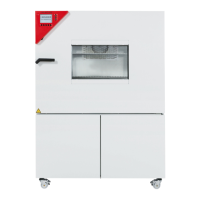
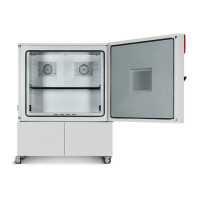
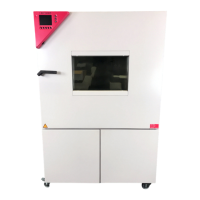
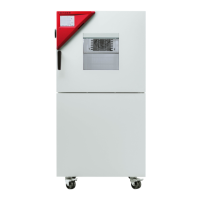
Provides a general visual and functional description of the chamber models.
Describes the main control interface, display, buttons, and icons.
Details the switches, interfaces, and ports on the chamber's side.
Steps for receiving, unpacking, and verifying chamber contents and for damage.
Guidelines for safely moving and transporting the chamber to prevent injury or damage.
Specifies requirements for the chamber's location, ventilation, and environmental conditions.
Instructions for connecting the wastewater outlet for the humidifying system.
Details on connecting freshwater for the humidifying system (auto/manual).
Procedure for connecting the cooling water inlet for water-cooled models.
Information on safely connecting the chamber to the power supply.
Explains the functions and icons visible in the normal operating display.
Describes how to switch between normal, program, and chart recorder views.
Outlines the different modes the MB2 controller can operate in (Idle, Fixed Value, etc.).
Overview of the main menu hierarchy and navigation paths.
Step-by-step guide for powering on the chamber and controller.
Initial controller configuration steps like language and time zone.
How to set temperature, humidity, and fan speed using the setpoints menu.
Method for entering set-points directly from the normal display.
Configuration of operation lines for advanced functions like humidity off.
Instructions for initiating a timer-based program with specific duration.
Procedures for pausing or canceling an active timer program.
Describes the controller's behavior and transition after a timer program concludes.
How to select and start a pre-programmed time sequence.
Step-by-step guide for programming custom time-based temperature cycles.
Tools for managing, copying, and deleting time programs.
Functions for adding, copying, replacing, or deleting program sections within a time program.
Setting parameters like duration, ramp/step, and setpoints for program sections.
How to select and initiate a programmed weekly temperature/humidity cycle.
Guide for programming custom weekly temperature and humidity cycles.
Managing week programs, including name changes and copying.
Tools for adding, copying, replacing, or deleting sections in week programs.
Setting parameters like weekday, start time, and setpoints for week program sections.
Overview of system notifications, alarm messages, and their meanings.
Visual and audible indicators of an alarm condition on the controller.
Procedures for acknowledging and clearing active alarms.
How to activate or deactivate the controller's audible alarm (buzzer).
Describes the primary internal safety device for over-temperature protection.
Details the secondary safety controller and its modes (Limit, Offset).
Configuration and function of the optional class 2 safety device.
Explains different user roles and password protection for controller access.
Steps required to log in to the controller with a specific authorization level.
How to securely log out from the controller interface.
Procedures for changing, deleting, or assigning passwords for user levels.
How to use activation codes to unlock additional controller functions.
How to select the display language for the controller interface.
Essential steps for configuring the chamber's date, time, and daylight saving.
Adjusting display brightness, screen saver, and continuous operation settings.
Configuring serial interfaces, Ethernet, Web server, and E-Mail settings.
How to transfer data (logs, programs) to and from the chamber via USB.
Contact details for BINDER service and support.
How to view real-time chamber status, setpoints, and actual values.
Accessing and understanding the log of chamber events and errors.
Performing automated checks of chamber functions for fault analysis.
Functionality for showing/hiding legends, switching pages, and displaying indications.
Configuring storage interval, value types, and scaling for recorded data.
Explains how the system works, including freshwater and wastewater management.
Manual procedure for removing ice buildup on the evaporator plates.
How to use the feature to prevent condensation on samples during warming.
Describes the outputs for switching external devices and their connection.
Details on the optional software for chamber management and control.
Information on optional kits for long-term temperature and humidity data logging.
Requirements and connection method for optional compressed air supply.
How to use the water cooling option instead of air cooling.
Setup for manual freshwater and wastewater supply using external cans.
Guidelines for routine cleaning of the chamber interior and exterior.
Procedures for cleaning after contamination with hazardous substances.
Overview of maintenance requirements and personnel qualifications.
Recommended schedule for maintenance and service tasks.
Common issues and their solutions for operating personnel.
Process and requirements for sending the chamber back for repair.
Proper disposal methods for packaging materials like boxes and foam.
Steps to safely prepare the chamber for disposal or long-term storage.
Regulations for disposing of the chamber in Germany according to WEEE.
Guidelines for chamber disposal in EU countries outside Germany.
Information about the chamber's factory calibration and recommended recalibration.
Detailed technical specifications for MKF series chambers (dimensions, performance).
Detailed technical specifications for MKFT series chambers (dimensions, performance).
Visual representation of MKF chamber heating and cooling performance over time.
Overall physical dimensions and layout drawings of the chamber models.
Official document confirming the MKF chamber's compliance with EU directives.
Official document confirming the MKFT chamber's compliance with EU directives.
Certification indicating compliance with German product safety standards (GS mark).
Instructions on how to register the chamber online for warranty and support.
Information about the included Multi Management Software and its features.
Form required for returning equipment, detailing hazardous substances.
Form required for returning equipment to USA/Canada, detailing hazardous substances.
 General
| Humidity Range | 10 % to 98 % RH |
|---|---|
| Humidity Fluctuation | ± 1.5 % RH |
| Temperature Range | -40 °C to 180 °C |
| Volume | 240 l |
| Power Supply | 230V, 50/60Hz (varies by model) |