Chapter 5 Programmable Parameters
Evia HF / HF-T Technical Manual
PAGE 18
CAUTION
Programming Modication Extreme programming changes should
only be made after careful clinical assessment. Clinical judgment
should be used when programming permanent pacing rates below
40 ppm or above 100 ppm.
5.2.2 Rate Hysteresis
Parameter Name Range Standard Value Unit
Rate Hysteresis OFF, -5...(-5)...-90 OFF bpm
Scan Hysteresis OFF, 1...(1)...15 OFF cycles
Repetitive Hysteresis OFF, 1...(1)...15 OFF cycles
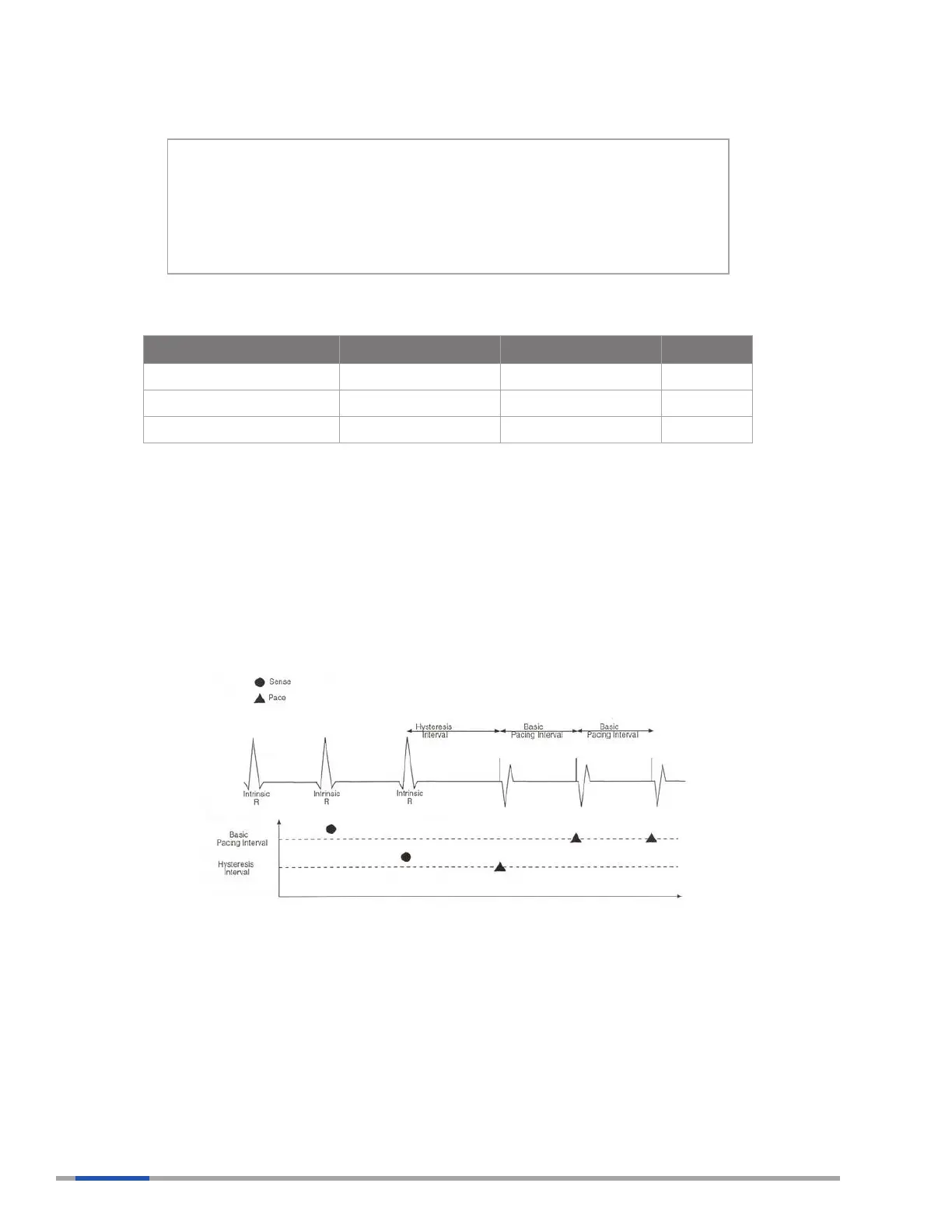
Rate Hysteresis may be programmed to promote intrinsic conduction for patients who can tolerate
intrinsic activity below a programmed pacing or sensor-indicated rate. This hysteresis rate becomes
the lowest rate permitted before the device begins pacing. Rate hysteresis requires a sensed event
in order to activate. Rate hysteresis will remain active as long as the intrinsic activity remains above
the programmed hysteresis rate. When the intrinsic rate falls to the hysteresis rate, the device will
deliver one paced event at the hysteresis rate and then begin pacing at the programmed basic rate.
Pacing will remain at the basic/sensor rate until a new intrinsic event occurs. This new intrinsic event
reactivates rate hysteresis. An example is shown in Figure 3. Features such as scan and repetitive
hysteresis are available to promote intrinsic activity and are discussed in this chapter.
Figure 3: Example of Rate Hysteresis
Repetitive Rate Hysteresis and Scan Rate Hysteresis are Rate Hysteresis enhancements available in
the Evia CRT-P family. These features encourage a patient’s own rhythm, periodically allowing for, or
looking for, intrinsic activity.
NOTE:
If rate adaptation is active, the Hysteresis rate is based on the current sensor-indicated rate and the
value of the programmable parameter.
Hysteresis is not available in CLS or DVI, and DVIR modes.



 To Next Page