Chapter 5 Programmable Parameters
Evia HF / HF-T Technical Manual
PAGE 24
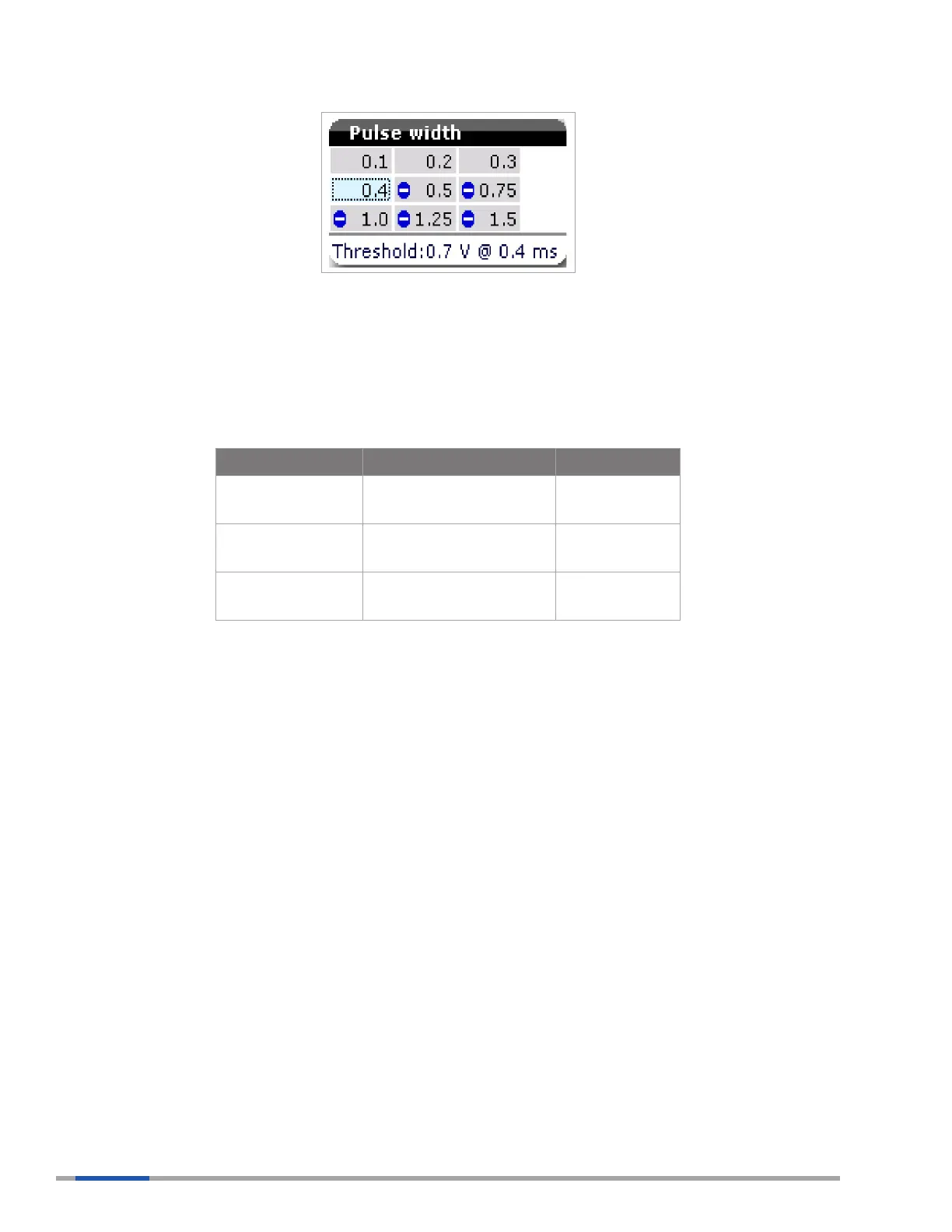
Figure 8: Pulse Width
NOTE:
When VCC is programmed to ON or ATM, the pulse width cannot be programmed to a value higher
than 0.4 ms.
5.4 Automatic Sensitivity Control (ASC)
Chamber Range Default
Atrium
Auto, 0.1...(0.l)...1.5...
(0.5)...7.5 mV
Auto
Right Ventricle
Auto, 0.5...(0.5)...
7.5 mV
Auto
Left Ventricle
OFF, Auto, 0.5...
(0.5)...7.5 mV
Auto
The parameter “sensitivity” is used to set the pulse generator’s threshold for detecting intracardiac
signals. The lower the programmed sensitivity value, the higher the device’s sensitivity.
If intracardiac signals are of low amplitude, a change to a higher sensitivity (lower value) may be
necessary. Conversely, if the sensing amplier is responding to extraneous signals, such as artifact
or interference, a change to a lower sensitivity (higher value) may resolve the difculty. In dual-
chamber sensing modes, the sensitivity values for the atrial and ventricular channels are independently
programmable.
With unipolar sensing, the lowest sensitivity setting is 0.5 mV in the atrium. Blue conict icons for the
atrial channel shown in Figure 9 show a conict message, requiring the user to program the lead to a
bipolar conguration before the value can be permanently programmed.
A conict will appear when attempting to program 0.5 mV in the ventricle, as shown in Figure 9, with
unipolar sensing. The user is asked to extend the Ventricular Blanking after Ap to resolve the conict.
This is done to reduce the potential of oversensing the atrial pacing spike with unipolar sensing. Once
resolved, the user can program 0.5 mV sensitivity in the ventricle.
If a sensing test has been performed, the sensing value is displayed at the bottom of the sensitivity
parameter to guide sensing programming of the device.



 To Next Page