Chapter 5 Programmable Parameters
Evia HF / HF-T Technical Manual
PAGE 42
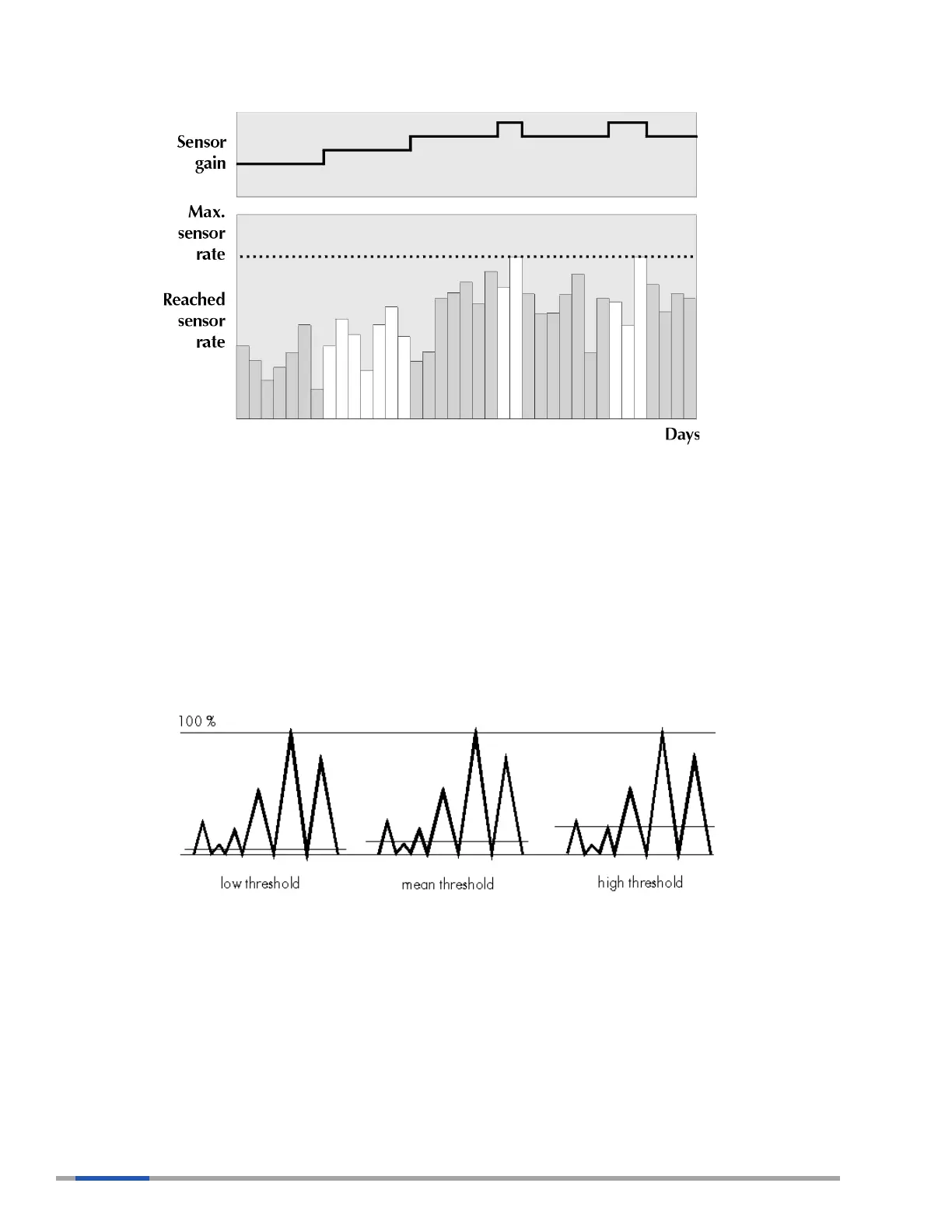
Figure 27: Automatic Sensor Gain
5.7.3 Sensor Threshold
The effects of rate adaptation are limited to sensor signals exceeding the programmable sensor
threshold. Sensor signals below this threshold do not affect rate response (Figure 28). The
programmable sensor threshold ensures that a stable rate at rest can be achieved by ignoring sensor
signals of low amplitude that are not related to exertion.
If the pacing rate at rest is unstable, or tends to stay above the lower rate without activity, the sensor
threshold should be increased. The sensor threshold should be reduced if a sufcient rate increase is
not observed at a given level of exertion.
Figure 28: Effect of Sensor Threshold
5.7.4 Rate Increase
The rate increase parameter determines the maximum rate of change in the pacing rate if the sensor
signal indicates increasing exertion (Table 11). In DDDR, VDDR, DOOR, VVIR, VOOR, AAIR and
AOOR, a rate increase setting of 2 ppm per second increase in pacing rate would take 45 seconds to
change from a pacing rate of 60 ppm to 150 ppm.



 To Next Page