Chapter 5 Programmable Parameters
Evia HF / HF-T Technical Manual
PAGE 39
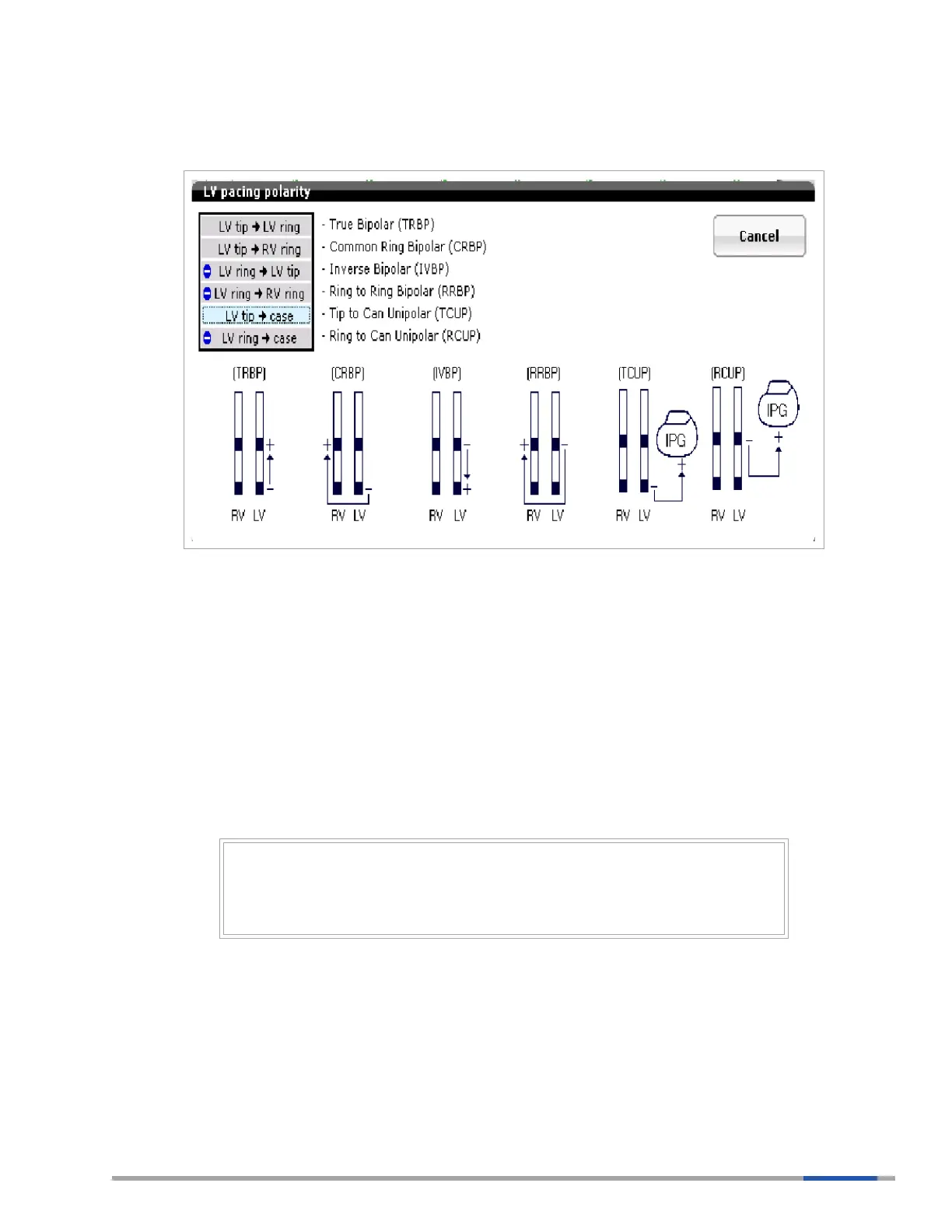
Lead polarity can be programmed separately for sensing and pacing in the atrium and ventricles.
Figure 23: LV Pacing Options
The programmed lead polarity determines whether the pulse generator senses or paces in a unipolar
or bipolar conguration. Lead polarity can be programmed separately for sensing and pacing in both
chambers.
If a bipolar lead is connected to the pulse generator, unipolar or bipolar conguration can be
programmed for pacing and sensing. As compared to bipolar pacing, the unipolar pacing pulse has
the advantage of being clearly identiable on the ECG. Unipolar pacing occasionally results in muscle
stimulation in the pulse generator pocket or diaphragm.
Bipolar sensing offers an improved “signal-to-noise” ratio due to the decreased susceptibility to
interference signals like skeletal myopotentials or EMI, and, therefore, permits programming of higher
sensitivities (lower values).
WARNING
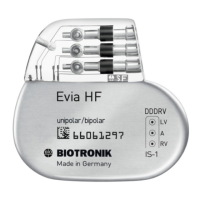
Unipolar/Bipolar All Evia CRT-P models can be used with either
unipolar or bipolar IS-1 leads.
5.7 Parameters for Rate-Adaptive Pacing
The Evia CRT-P achieves rate adaption through programming of either standard motion-based pacing
via a capacitive accelerometer or by the means of the principle of closed loop stimulation (CLS) which
involves the translation of myocardial contractility into patient-specic pacing rates.
For standard motion-based rate adaption, the pulse generator is equipped with an accelerometer
located on the hybrid circuit of the pulse generator. This sensor produces an electric signal during
physical activity of the patient. If a rate-adaptive mode is programmed, then the sensor signal controls



 To Next Page