Chapter 5 Programmable Parameters
Evia HF / HF-T Technical Manual
PAGE 22
The programmer automatically updates the pulse generator time-of-day clock each time the pulse
generator is programmed.
The actual time when the respective increase or decrease in rate occurs may begin up to 4 minutes
after the programmed time because of internal pulse generator timing.
5.2.6 Rate Fading
Rate Fading is intended to prevent a sudden drop in heart rate when the pulse generator transitions
from tracking an intrinsic rhythm to pacing due to an abrupt decrease in the intrinsic rate, in order to
prevent potential reactions such as dizziness, light headedness, lack of energy and fainting.
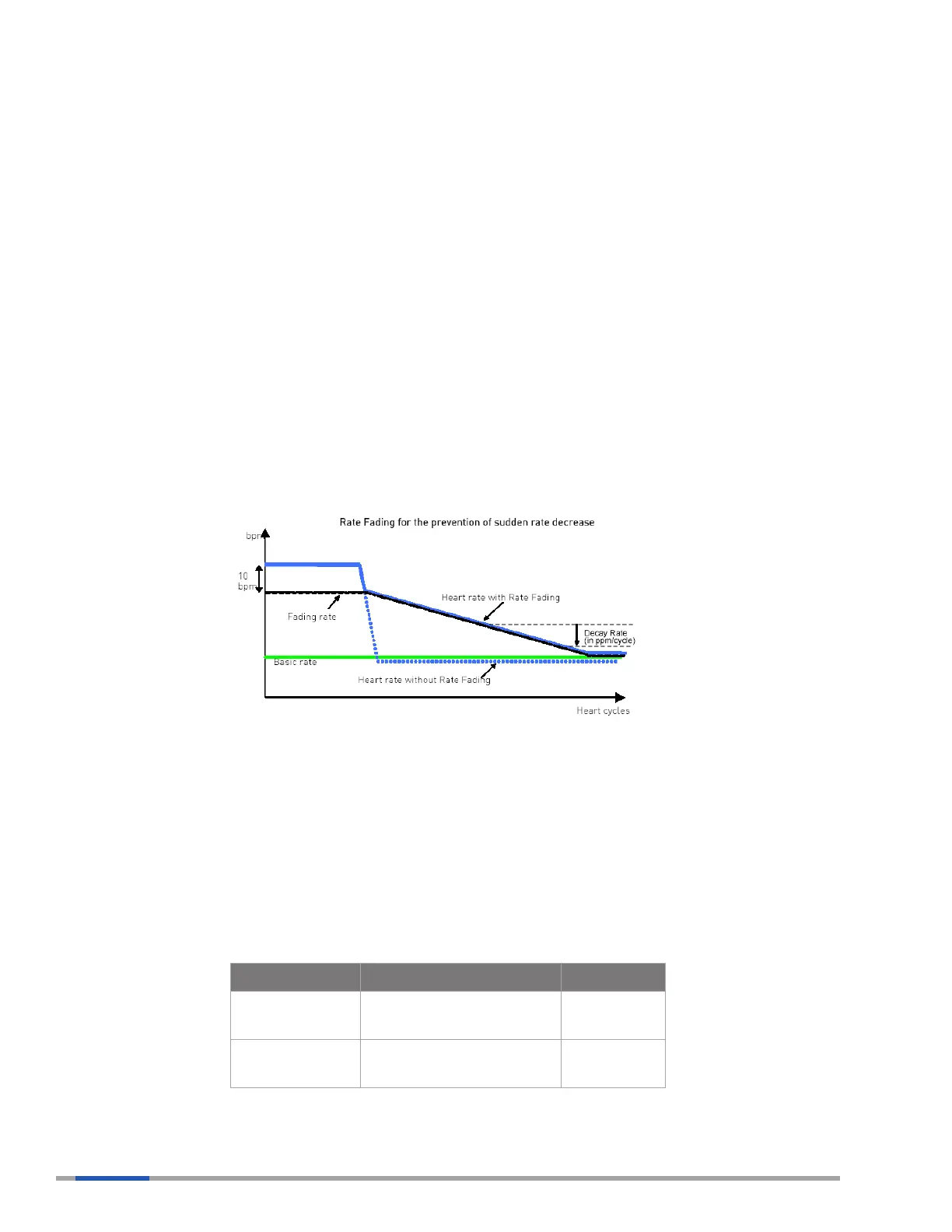
With Rate Fading enabled, the pulse generator calculates the Fading Rate, which is a four beat
average of the intrinsic rate reduced by 10 ppm. When the intrinsic rate drops considerably (below the
Fading Rate), the pacing rate begins at the RF rate and then decreases gradually by the programmable
Decay Rate to the Sensor Indicated Rate or Basic Rate.
NOTE:
The Fading Rate cannot exceed the programmed Maximum Activity Rate and cannot increase faster
than the RF Rate decrease (programmable in ppm/cycle).
Figure 7: Rate Fading
The Rate Fading feature is available after 10 ASYNC while in magnet mode and disabled at ERI and in
backup mode.
5.3 Pulse Specic Features
Features related to the pacing pulse.
5.3.1 Pulse Amplitude
The pulse amplitude can be programmed as shown in Table 3.
Chamber Range Default
Atrium
0.2...(0.1)...3.0...
(.1)...6.0...(0.5)...7.5 V
3.0 V
Right/Left
Ventricle
0.2...(0.1)...3.0...
(.1)...6.0...(0.5)...7.5 V
3.0 V
Table 3: Pulse Amplitude Parameters



 To Next Page