Chapter 5 Programmable Parameters
Evia HF / HF-T Technical Manual
PAGE 37
The blanking time shall be as short as possible in order to provide ventricular sensing when a
ventricular depolarization could occur.
Crosstalk may be encountered if a shorter blanking time, unipolar ventricular sensing, a higher
ventricular sensitivity (lower value) and/or a high atrial pulse amplitude and pulse width are
programmed.
5.5.6 Far-Field Protection
Far-eld Protection after Vs - 100...(10)...220 ms; default 100 ms
Far-eld Protection after Vp - 100...(10)...220 ms; default 150 ms
Inappropriate mode switches may occur in the presence of atrial oversensing of ventricular events. This
scenario is seen when mode switches are recorded in the diagnostics of the pacemaker in the absence
of true documented atrial arrhythmias. To aid in diagnosis, a recorded IEGM will demonstrate a
rhythmic pattern of a sensed atrial event followed by an atrial refractory event (ARS) at or just following
the ventricular event. This may occur with both sensed and paced ventricular events.
The Far-Field Protection in the atrial channel feature affects both sensed and paced events originating
from the ventricle and sensed on the atrial channel. The programming resolution for Far-Field
Protection is 100 ms to 220 ms following a Vs event, and 100 ms to 220 ms following a Vp event. The
shortest Far-Field Blanking period that will cover the atrial refractory sensed events is recommended to
prevent undersensing of true atrial events. Events sensed within this timer are annotated as Ars (FFP)
events and are not counted toward Mode Switching.
5.5.7 Safety AV Delay
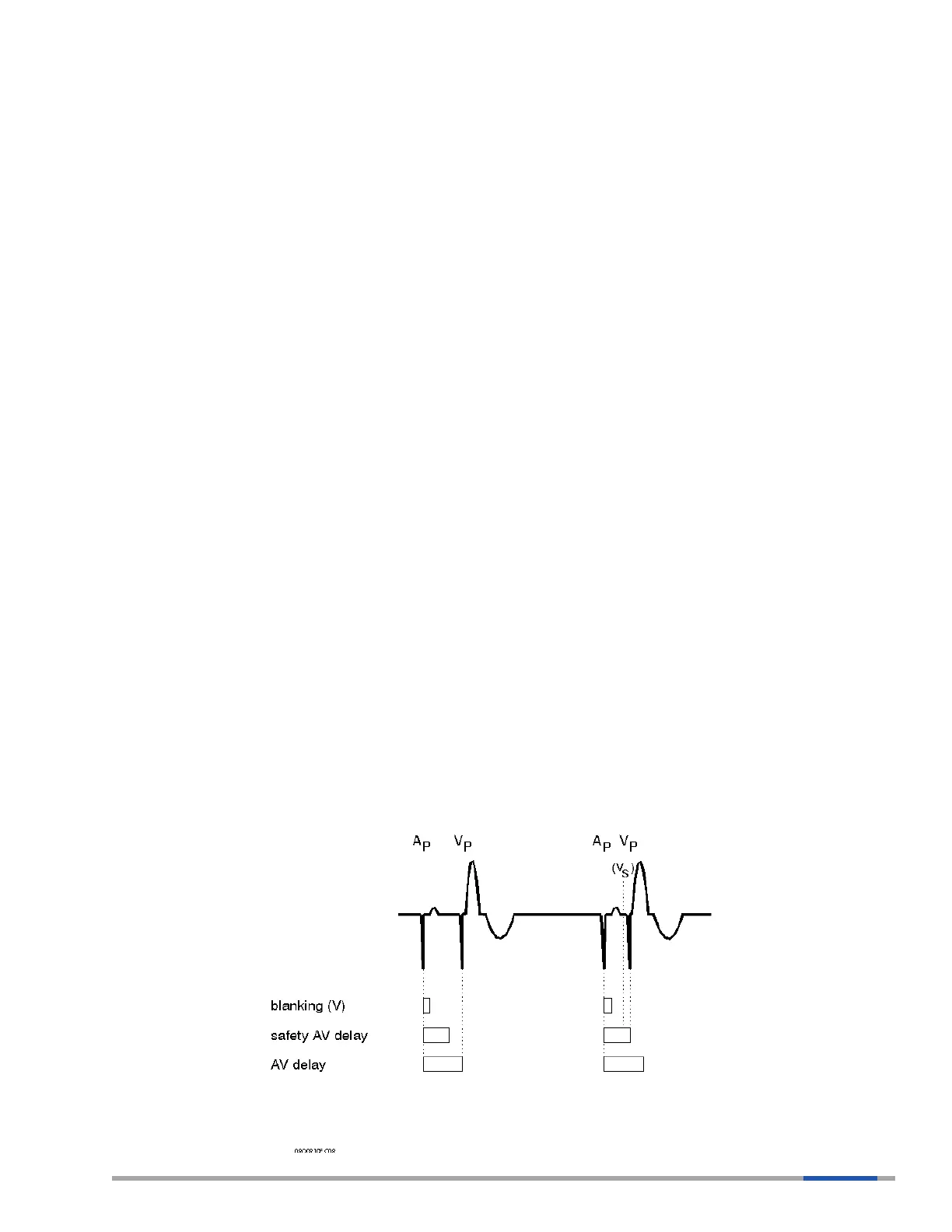
The safety AV delay (set at 100 ms) applies to the pacing modes DDD-CLS, DDD(R), DVI(R), DDI(R),
and DDD(R)-ADI(R).
To prevent ventricular pulse inhibition in the presence of crosstalk, a ventricular pulse will be emitted
at the end of the safety AV delay (Figure 21). When pacing is AV sequential at the pre-set safety AV
delay, the presence of crosstalk should be considered and appropriate reprogramming performed
(lengthen the ventricular blanking time, lower ventricular sensitivity, bipolar conguration, and/or
lower atrial pulse energy).
Figure 21: Ventricular Blanking Time and Safety AV Delay (Dual Chamber)



 To Next Page