Chapter 6 Statistics
Evia HF / HF-T Technical Manual
PAGE 75
NOTE:
PVC events that have an intrinsic atrial event occurring within 350 ms before the Vs event will be
classied as an AsVs event and not a PVC. This is due to the As Discrimination feature of Evia CRT-P,
which is a hidden feature of the device. This feature is designed to improved event classication but
could classify PVC events as As Vs events if an atrial intrinsic event occurs within the 350 ms window
(400 ms window if I-Opt is programmed).
NOTE:
If in DDD(R) and atrial undersensing occurs, spontaneously conducted ventricular events are
evaluated as PVC events. For this reason, we recommend using the PVC analysis in DDD(R) mode
only in conjunction with bipolar sensing and an appropriately high atrial sensitivity.
The interval between two consecutive PVC events must be shorter than 500 ms (i.e., over 120 ppm)
for them to be counted. Otherwise, the second PVC will be ignored and the sequence interpreted or
terminated. This predominantly eliminates the possibility of PVC events being miscounted as a result of
atrial undersensing.
6.4 Sensor Statistics
6.4.1 Sensor Histogram
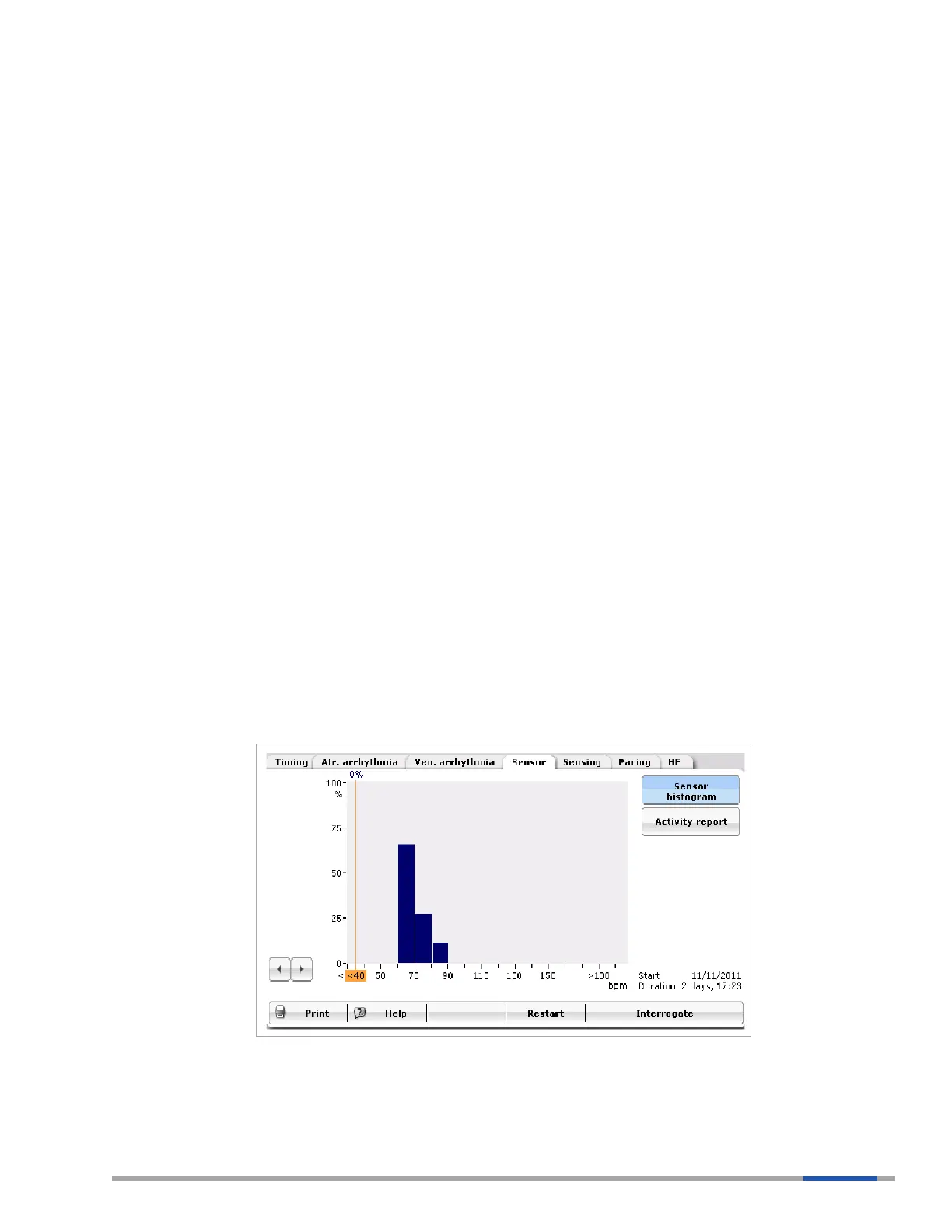
This function records how often the sensor rate is within certain ranges. The rate range is subdivided
into 16 rate classes going from 40 to 180, including bins for rates < 40 bpm and rates > 180 bpm. The
percentage and total number of sensed and paced events occurring within a rate class is displayed.
Sensor rate recording is independent of the effectiveness of the respective pacing rate, and it is not
inuenced by inhibition of pacing due to spontaneous events. Rate data are also recorded in non-rate-
adaptive modes.
Recording stops when the memory available for recording the sensor rates is full. Recordings can be
stored for several years. The frequency distribution of the sensor rates can be displayed as a diagram
during follow-up examinations.
Figure 44: Sensor Histogram
The Sensor rate histogram graph in Figure 44 shows the sensor activity during the recording time.
Data is collected even if the device is programmed to a non-sensor mode to demonstrate what the
sensor response would have been. In chronotropically incompetent patients, one would expect this



 To Next Page