Chapter 5 Programmable Parameters
Evia HF / HF-T Technical Manual
PAGE 45
Termination
The pulse generator will immediately mode switch to a non-atrial tracking mode (e.g., DDDR to
DDIR) when the conrmation criteria have been met, and then the 2:1 Lock-In Management feature is
suspended until the pulse generator mode switches back to the programmed pacing mode.
In order to optimize the programmability of the 2:1 Lock-In Management feature, the far eld protection
period is programmable to allow the physician to ensure that the protection period is sufcient to
recognize cases where a 2:1 lock-in is likely to occur.
5.9 Atrial Upper Rate
The atrial upper rate (AUR) prevents atrial pacing from occurring in the vulnerable phase after an atrial
sensed event during the PMT protection interval, and ensures that the next atrial paced event occurs
after the heart’s natural atrial refractory period.
To avoid this, an atrial upper rate of 240 ppm (atrial upper interval (AUI), 250 ms) is started after
a PMT-As.
The next Ap can only be emitted after the expiration of the AUI. When there are high sensor rates, the
atrial pacing is shifted.
NOTE:
Right atrial pacing does not occur when mode switching is activated, and when the atrial upper rate
is activated in DDI mode at the end of the sensor or basic interval.
5.10 Atrial Overdrive Pacing (Overdrive Mode)
The atrial pacing rate increases after each atrial sensed event that is not classied as an atrial
extrasystole, in an attempt to suppress atrial tachyarrhythmias. The overdrive algorithm triggers atrial
overdrive pacing and guarantees that pacing occurs at a rate slightly above the intrinsic sinus rate.
Atrial overdrive pacing thereby minimizes the number of atrial sensed events. The overdrive mode is
available in DDD(R).
The features of Atrial Overdrive pacing include:
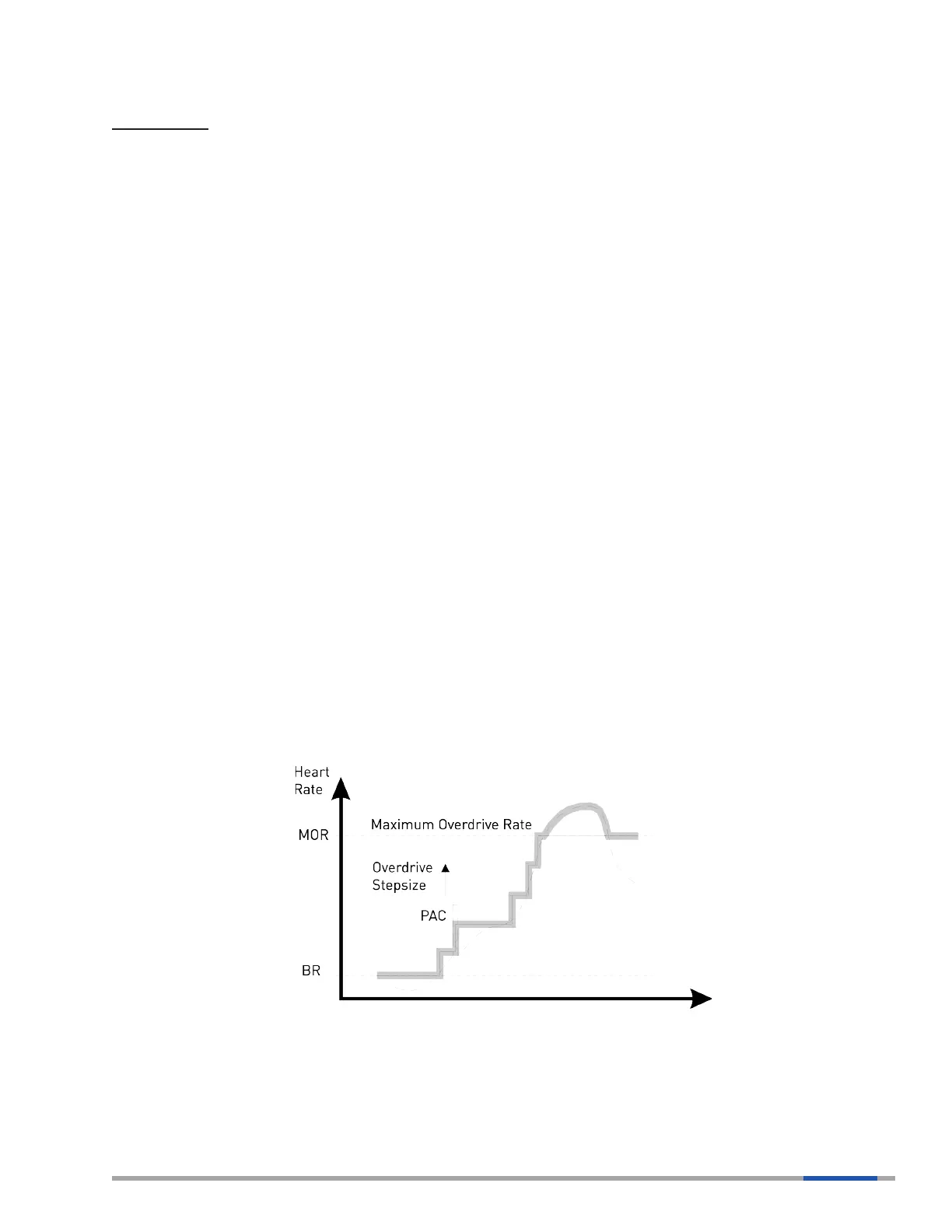
Figure 30: Overdrive Pacing
After every atrial sensed event (non-AES), the pacing rate is increased by a non-programmable 8 bpm
rate increase above the intrinsic event. This is shown as the overdrive step in Figure 30. The device will
pace at that rate (intrinsic + 8 bpm) for 20 cycles. At the end of those 20 cycles, the device will decrease
the pacing rate by 1 bpm/cycle until an intrinsic event is detected. Once an intrinsic event is detected, the
device will immediately increase the pacing rate to the new pacing rate (intrinsic rate + 8 bpm).



 To Next Page