Service Manual 04/2010 Rev.B
64
FAILURE IS ELECTRIC OR HYDRAULIC
PRESS THE COIL VALVE CORRESPONDENTS
TO THE DEFECTIVE HYDRAULIC MOVEMENT
(Fig. 93).
IF THE MACHINE WORKS NORMALLY BY
PRESSING THE COIL VALVE, THE PROBLEM
IS DUE TO AN ELECTRIC MALFUNCTION.
Fig.93
TO CONTROL THE CABLE:
Disconnect the machine from power supply.
Open the electric box (5.0).
Remove the wires cover (Fig.94).
Fig.94
Remove all portable control wires from
terminals block (Fig.95).
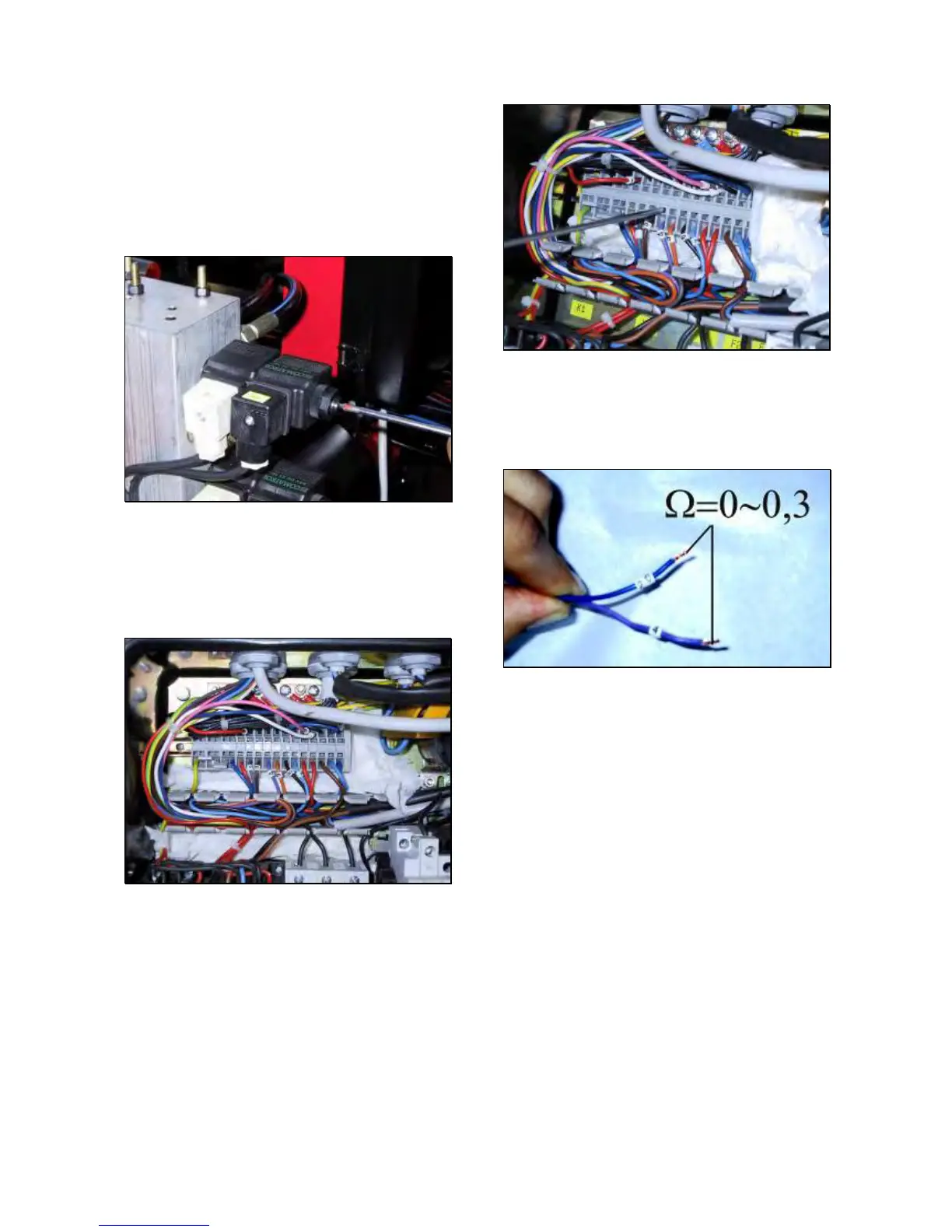
Take a multimeter and select it in Ohm.
Position a multimeter probe on a common end
(the n°1 is for the rotation pedals and the n°20
is for hydraulic commands) and the second
one on the supposed defective wire.
Press the correspondent command on the
portable control and verify if there is continuity
between the two ends (Fig.96)
Fig.95
If there is not continuity remove the suspected
wrong wire from the correspondent micro
switch and verify if there is continuity between
the two ends of the same wire.
Fig.96
TO REPLACE THE CABLE:
Disconnect the machine from power supply.
Open the electric box (5.0).
Remove all remote control wires from
terminals block (Fig.94).
Remove all wires from all micro switches
Remove the defective cable from the portable
control.
Connect by tape the old cable with the new
one to insert the new cable through the inner
cabinet holes.
Release cable strain relief on the electric box.
Take the defective cable away.
Insert the new cable through the strain relief.
Connect all wires FIRMLY to the terminals
block of the electric box, following the
numbers reported on each one .
Tighten the cable strain relief.
Insert 3 steel wires through 8 and 2 position
switches and, only on CE proved machines,
emergency switch seats in order to drive
easily the new wires to the correct direction
inside of the portable control.
Tighten the rotation wire FIRMLY to their
switches in the bottom of the portable control.



 To Next Page