Setup
34 ©2021 CAE 905K351052 v1.1
CAEApollo
Step b: Pour the Fluid into the Trauma Fill Tank
Pour the desired amount of fluid into the Trauma Fill Tank, being careful to NOT to exceed 6 liters (1.6
gallons) of fluid.
Note: The right thigh tank holds 1.5 liters and is used for blood.
Three (3) liters of simulated blood provides enough fluid to fill the right thigh reservoir twice. The
amount of blood used in a training session varies with the patient, the wounds simulated and the
learner’s experience.
Step c: Connect the Trauma Fill Tank Connector to the Simulator
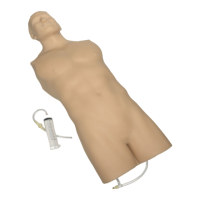
Locate the tan FILL port and white VENT port.
Connect the FILL (with the tan label) and VENT (with the white label) hoses of the trauma fill tank to
the corresponding ports on the simulator.
Note: Both connections must be made for correct operation.
Step d: Pressurize the Trauma Fill Tank and Fill the On-Board Blood
Reservoir
An integrated hand pump is used to create the pressure for the Trauma Fill Tank.
WARNING: To prevent ejected pump assembly and/or solution from striking and injuring you, NEVER
stand with your face or body directly over the top of the tank when pumping or loosening the pump.
To operate the pump and fill the reservoir:
1. Unlock the pump handle by turning counter-clockwise. Be careful not to loosen the pump
from the tank.
2. Stroke the pump handle up and down from 25 to 35 times to transport 2 liters of
simulated blood to the on-board blood reservoir. NEVER exceed 35 strokes while
pressurizing the tank.
3. Lock the pump handle back into the pump assembly by turning clockwise.
4. Watch the Overflow Bottle located on the tank assembly. When liquid begins to appear in
this bottle, the on-board blood reservoir is full. Filling the on-board blood reservoir takes
approximately 3 to 5 minutes.


 To Next Page