Need help?
Do you have a question about the CAE Aria and is the answer not in the manual?
Important safety guidelines related to power sources, grounding, and cords for the simulator.
Guidelines for safe setup, cleaning, and operation of the manikin and its components.
Specific warnings for operating the manikin, tablet, and wireless modules safely.
Warning regarding latex in IV cannulation tubing for users with sensitivities.
Precautions for using the fluids system and avoiding skin contact with sharp parts.
Guidelines for handling, replacing, and safety information for simulator batteries.
Information on health effects from exposure to battery leaks or contents.
General safety measures and guidelines for shipping Li-ion batteries.
Details on the manikin's size, weight, and ambient temperature operating ranges.
Specifications for power adapters, batteries, and wireless communication.
Specifications for defibrillation and pacing capabilities of the simulator.
Introduction to the CAE Aria simulator and its configurations.
Details on components included in Live, Advanced, and Optional Aria configurations.
Description of the standard components included with each simulator configuration.
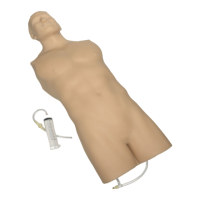
Details on the full body manikin, interchangeable genitalia, and wigs.
Information on the gown, accessories kit, NIBP arm, and BP cuff T-adapter.
Equipment for Live/Advanced configurations and CAE Maestro software.
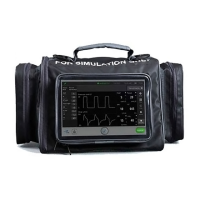
Details about the Surface Go 2 tablet and its carrying case.
Information on CAE StethoSym, CAE SymEyes, and CAE SymDefib.
Details on the SpO2 finger probe and optional equipment.
Guidelines for safely unpacking the manikin and preparing the workspace.
Step-by-step instructions for setting up the Aria simulator system.
How the manikin simulates patient reactions via physiological models and articulation.
Features and controls for the manikin's neurological system.
Details the realistic simulation of the manikin's respiratory system.
Details the simulation of hemodynamic conditions and responses.
Features for gastrointestinal and genitourinary system practice.
Capabilities for practicing emergency care skills with medication.
Overview of preconfigured scenarios for patient simulation.
How to manage scenarios and use system controls.
Overview of CAE Maestro software for controlling simulator features.
Specific features and controls for the manikin's neurological system.
Manual and software controls for neurological system features.
Details on controlling simulator eye states like blink and pupil reactivity.
Features for managing the manikin's upper airway and intubation.
Procedures for mainstem intubation, laryngospasm, and tracheostomy.
Simulation of chest excursion and ventilation procedures.
Procedures for cricothyrotomy, pneumothorax decompression, and chest tube.
Features for practicing cardiovascular assessment and life support.
Controls for heart sounds, ECG, pulses, and blood pressure.
Details on locations and characteristics of bilateral pulses.
Details on IV sites, preparation, and cannulation procedures.
Sites and procedures for IM/SQ and IO injections.
Chest compressions, CPR monitoring, and ECG connection.
Defibrillation, cardioversion, pacing, and related safety precautions.
Charging and using the SymDefib device for defibrillation.
Achieving pacing and taking blood pressure measurements.
Procedure for performing fingerstick blood glucose testing.
Using the SpO2 finger probe for plethysmogram display.
Simulating bowel sounds and genitourinary system functions.
Procedures for urinary catheterization and changing genitalia.
Simulating body sounds, speech, and using the StethoSym.
Setting up and operating the StethoSym for sound auscultation.
RFID tag locations and charging the StethoSym.
Guidelines for general simulator care and breakdown procedures.
Procedures for maintenance and visual inspection of the simulator.
Guidelines for short-term and long-term storage of the simulator.
Lists recommended sizes for various clinical supplies used with Aria.
 General
| Brand | CAE |
|---|---|
| Model | Aria |
| Category | Medical Equipment |
| Language | English |


 To Next Page