©2021 CAE 905K690052 v1.0 71
Using Aria
Cardioversion
The cardioversion procedure will vary depending upon the brand of defibrillator that is being used.
However, the setup steps for the defibrillator will be the same as that described in the preceding
section. Refer to defibrillator manufacturer’s user guide for proper use.
Pacing
Pacing can be achieved by selecting the appropriate intervention in Electrical Therapy within the
Treatments button on the right side of the Run screen in the Maestro software.
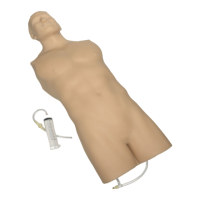
Connect the ECG leads to the posts on the manikin. This provides ECG signals for leads I – III. The
learner may choose to shock either synchronously or asynchronously to the ECG rhythm. The Pacing
Capture Threshold can be modified in the Maestro software.
The default threshold is set at 50 mA.
When the current exceeds the Pacing Capture Threshold set in Maestro, the learner begins to see the
effect of pacing on the ECG and Maestro logs the current being provided.
A standard transthoracic cardiac pacemaker can be connected to the simulator using the anterior
contacts. The simulator automatically detects and responds to pacing signals (from 20 mA to 200 mA,
in increments of 10).
For more information, see the Maestro for Aria User Guide.
Blood Pressure
Aria supports non-invasive blood pressure measurements, and systolic and diastolic readings can be
obtained and manipulated through the software.
Systolic and Diastolic Blood Pressure
To manually adjust the systolic and/or diastolic blood pressure:
1. From the Cardiovascular panel, select the parameter of desired blood pressure.
2. Set the pressure by moving the blue slider left or right, or by typing in a value.
Non-Invasive Blood Pressure Measurement
Blood pressure can be taken manually on the right arm. Non-invasive blood pressure (NIBP)
monitoring techniques can be used by attaching a standard cuff modified with a T-fitting and
adapters.



 To Next Page