Using Apollo
38 ©2020 CAE 905K351052 v1.1
CAEApollo
Head Secretions (Prehospital Only)
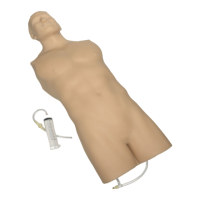
Secretions of the eyes, nose, and mouth are manually controlled with a gravity feed.
Note: An IV bag is needed for each site in use.
To use the head secretion features:
1. Using a 50 ml syringe, prime the line of the desired secretion by injecting fluid into the
NOSE, MOUTH or EYES port on Apollo’s left shoulder until fluid emerges from the
secretion sites.
2. Set up the IV pole near the simulator.
3. Fill an IV bag with the clinically appropriate fluid. Use distilled water only,
with food coloring, if desired.
4. Hang the IV bag on the IV pole.
5. Ensure the roller clamp is closed and insert the IV spike into the IV bag.
Eyes Eyes can be used as an indicator of a
patient’s condition and/or conscious-
ness during an assessment.
Tap Eyes on Run
screen and tap
desired status.
None.
Convulsions Simulated convulsions can be
activated at the facilitator’s
discretion.
Tap Neuro and
locate
Convulsions in
menu; use ON/
OFF toggle.
None required.
Temperature:
Body
Myocardial oxygen supply and
demand automatically influence the
cardiac rhythm, yielding response to
hypoxemia (Modeled only).
Tap Neuro and
tap Temperature:
Body to adjust.
None required.
Temperature:
Blood
Changes in arterial temperature may
alter the position of the standard
oxyhemoglobin dissociation curve
(shift). As temperature increases or
pH decreases, more oxygen is
released from hemoglobin and thus
the patient’s saturation decreases
(Modeled only).
Tap Neuro and
tap Temperature:
Blood to adjust.
None required.
Head
Secretions
(Prehospital)
Secretions of the eyes, nose, and
mouth are manually controlled with
a gravity feed.
None required. Instill using NOSE,
MOUTH or EYES
port (Prehospital
only).
Neurologic System Controls
Anatomy,
Physiology and
Clinical Signs
Clinical Interventions, Patient
Monitoring and Scenarios.
Software Control Manual Control


 To Next Page