©2020 CAE 905K351052 v1.1 47
Using Apollo
Airway Management
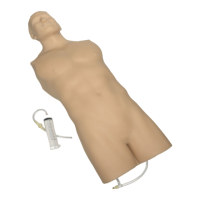
The manikin’s anatomically realistic upper airway provides for the opportunity to intubate the adult
patient, while various clinical signs (e.g., lung sounds, chest excursion, airway patency) can be
simulated using software commands. Other airway features include:
• Hard and Soft Palate
• Oropharynx
• Nasopharynx
• Laryngopharynx
Ventilation
Apollo supports manual bag-valve-mask (BVM) ventilation via face mask, airway adjuncts,
endotracheal tube, and tracheostomy tube. Proper ventilation will demonstrate chest rise and fall.
Positive Pressure Ventilation
When positive pressure ventilation is administered, the process is automatically detected by the
simulator, and the physiologic model is sensitive to the volume administered.
CO
2
Exhalation (Prehospital Only)
Whether supplied via a portable canister or from an external source, the simulator exhales CO
2
during positive pressure ventilation.
Note: An optional regulator kit must be purchased to use CO2 from an external source.
To use the CO
2
exhalation feature, connect the CO
2
canister to the CO
2
canister socket or connect the
external source on the simulator’s right shoulder, and Apollo Prehospital exhales CO
2
gas. There are
approximately 15 minutes of CO
2
gas available once the canister is connected.
Intubation
The upper airway of the Apollo manikin is designed to allow for intubation and laryngoscopy. Direct
laryngoscopy as well as oral and nasal tracheal intubation can be performed using devices such as
endotracheal tubes, nasopharyngeal airways, and oropharyngeal airways.
CAUTION: Airways can be damaged by improper insertion of an airway adjunct (such as
endotracheal tube). To protect the airway, lubricate the adjunct prior to insertion using the silicone oil
spray provided.
Use ONLY the provided SILICONE OIL to lubricate the adjunct. NEVER use a water-based lubricant.
Using a water-based lubricant can cause residue damage.


 To Next Page