Using Ares
74 ©2020 CAE 905K640152 v1.1
CAEAres
Using a Standard Defibrillator - Safety Precautions
Biphasic defibrillators can be used with either paddles or hands-free connectors. Standard
defibrillation energy levels should be used for positive learning reinforcement and to avoid negative
training transfer. However, please refer to the following cautions.
Use of a defibrillator for training purposes represents an operational hazard equivalent to use of a
defibrillator on a real patient. Consequently, ALL SAFETY PRECAUTIONS for the use of defibrillators
MUST BE FOLLOWED as if the simulator were a patient. Consult the specific defibrillator’s user
manual for further information.
The following cautions should be observed:
• Defibrillation should be performed on the defibrillation electrodes only. If defibrillation is
performed over any ECG electrode, high voltage may be present on the remaining
connectors during the shock. This may also damage ECG circuitry.
• To prevent overheating, do NOT provide more than three (3) defibrillator discharges
(maximum 200 joules with a biphasic defibrillator) in a sequence. Do NOT exceed an
average of two (2) defibrillator discharges per minute during the training session.
• Avoid a large number of consecutive discharges. For example, 20 or 25 discharges without
any recovery interval may damage the system.
• Do NOT let the simulator come in contact with electrically conductive surfaces or objects
during defibrillation. A flame-supporting atmosphere, for example, with a high content of
oxygen, should be avoided during defibrillation.
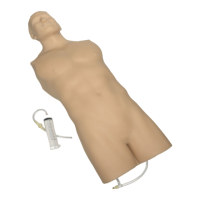
• Keep the simulator’s chest dry. Special attention should be taken when using the urinary
system or the chest tube feature.
• To prevent pitting of the chest skin electrode, do NOT apply conductive gel or conductive
defibrillation pads intended for patient use.
• Do NOT use cables or connectors having visible damage.
• Do NOT spill fluids over any component inside the simulator torso. This could damage the
system and may also present a possible hazard for the operator.
• When using a manual defibrillator, the ECG can be monitored via the defibrillator paddles.
Coarse ventricular fibrillation and high-rate ventricular tachycardia cardiac rhythms are
automatically recognized as “shockable” rhythms.
• With each defibrillation, Ares automatically records the amount of energy discharged and
the time defibrillation was performed. The simulated patient response to defibrillation is
determined by the scenario script or instructor intervention. Thus, cardioversion is not
automatically determined by the physiological models.
• The minimum electrical charge recognized by the circuitry within the simulator is 20
joules.



 To Next Page