EasyManua.ls Logo

Canon EOS 650D - Depth of Field Preview

Canon EOS 650D
376 pages
Print Icon
To Next Page IconTo Next Page
To Previous Page IconTo Previous Page
Loading...
112
f: Changing the Depth of Field
To obtain a correct flash exposure, the flash output will be set
automatically to match the set aperture (autoflash exposure). The
shutter speed will be set automatically between 1/200 sec. - 30 sec. to
suit the scene’s brightness.
In low light, the main subject is exposed with the automatic flash, and
the background is exposed with a slow shutter speed set automatically.
Both the subject and background look properly exposed (automatic
slow-speed flash sync). If you are handholding the camera, keep it
steady to prevent camera shake. Using a tripod is recommended.
To prevent a slow shutter speed, under [z1: Flash control], set
[Flash sync. speed in Av mode] to [1/200-1/60 sec. auto] or [1/200
sec. (fixed)] (p.215).
The aperture opening (diaphragm) changes only at the moment when
the picture is taken. Otherwise, the aperture remains fully open.
Therefore, when you look at the scene through the viewfinder or on the
LCD monitor, the depth of field will look narrow.
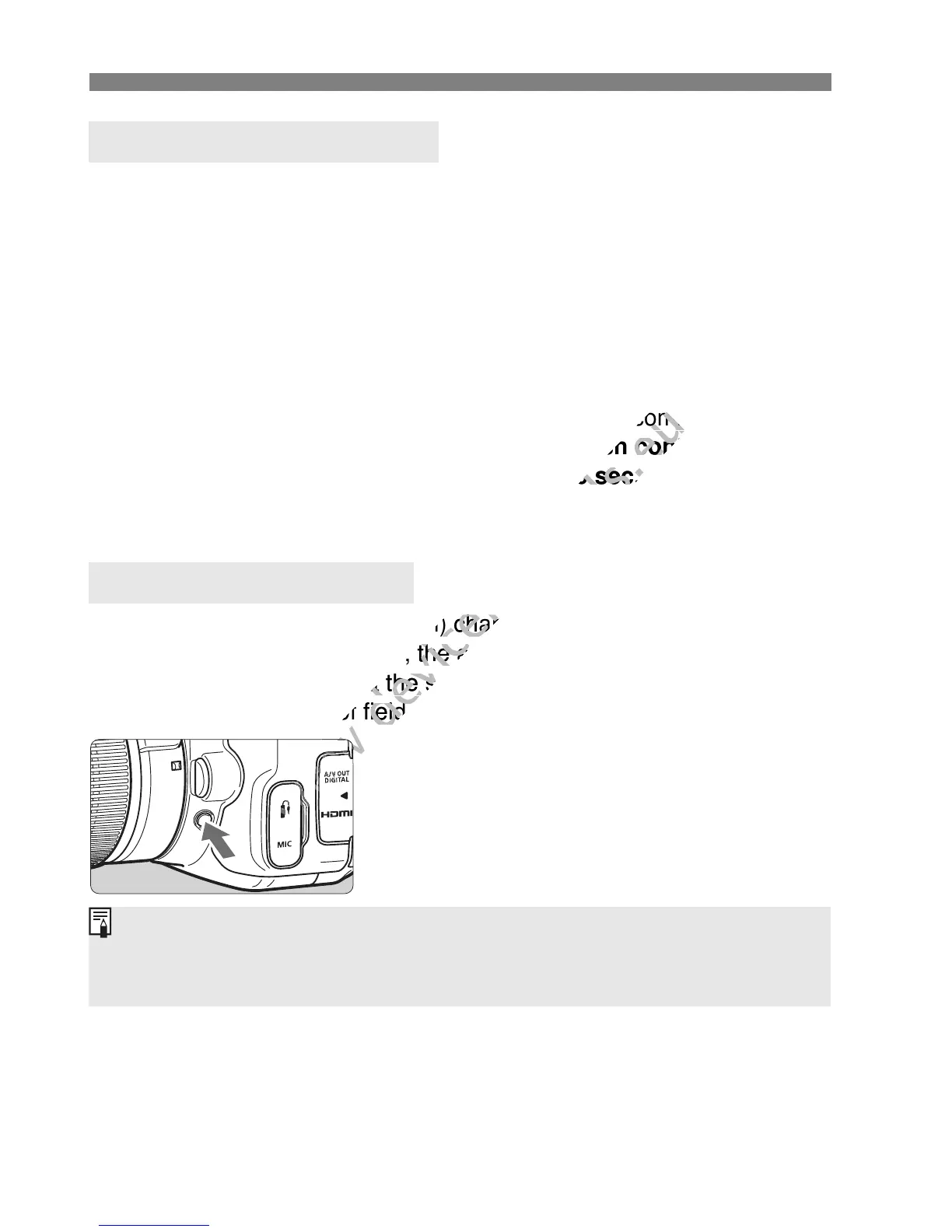
Press the depth-of-field preview button
to stop down the lens to the current
aperture setting and check the depth of
field (range of acceptable focus).
D Using the Built-in Flash
Depth of Field PreviewN
While looking at the Live View image (p.144) and holding down the depth-of-
field preview button, you can change the aperture and see how the depth of
field changes.
www.devicemanuals.eu
steady to prevent camera shake. Using a tripod is recommended.
www.devicemanuals.eu
steady to prevent camera shake. Using a tripod is recommended.
1: Flash control
www.devicemanuals.eu
1: Flash control
1/200-1/60 sec. auto
www.devicemanuals.eu
1/200-1/60 sec. auto
The aperture opening (diaphragm) changes only at the moment when
www.devicemanuals.eu
The aperture opening (diaphragm) changes only at the moment when
the picture is taken. Otherwise, the aperture remains fully open.
www.devicemanuals.eu
the picture is taken. Otherwise, the aperture remains fully open.
Therefore, when you look at the scene through the viewfinder or on the
www.devicemanuals.eu
Therefore, when you look at the scene through the viewfinder or on the
LCD monitor, the depth of field will look narrow.
www.devicemanuals.eu
LCD monitor, the depth of field will look narrow.
www.devicemanuals.eu

Table of Contents