Using a graphic display calculator
© Oxford University Press 2012: this may be reproduced for class use solely for the purchaser’s institute
Casio fx-9860GII
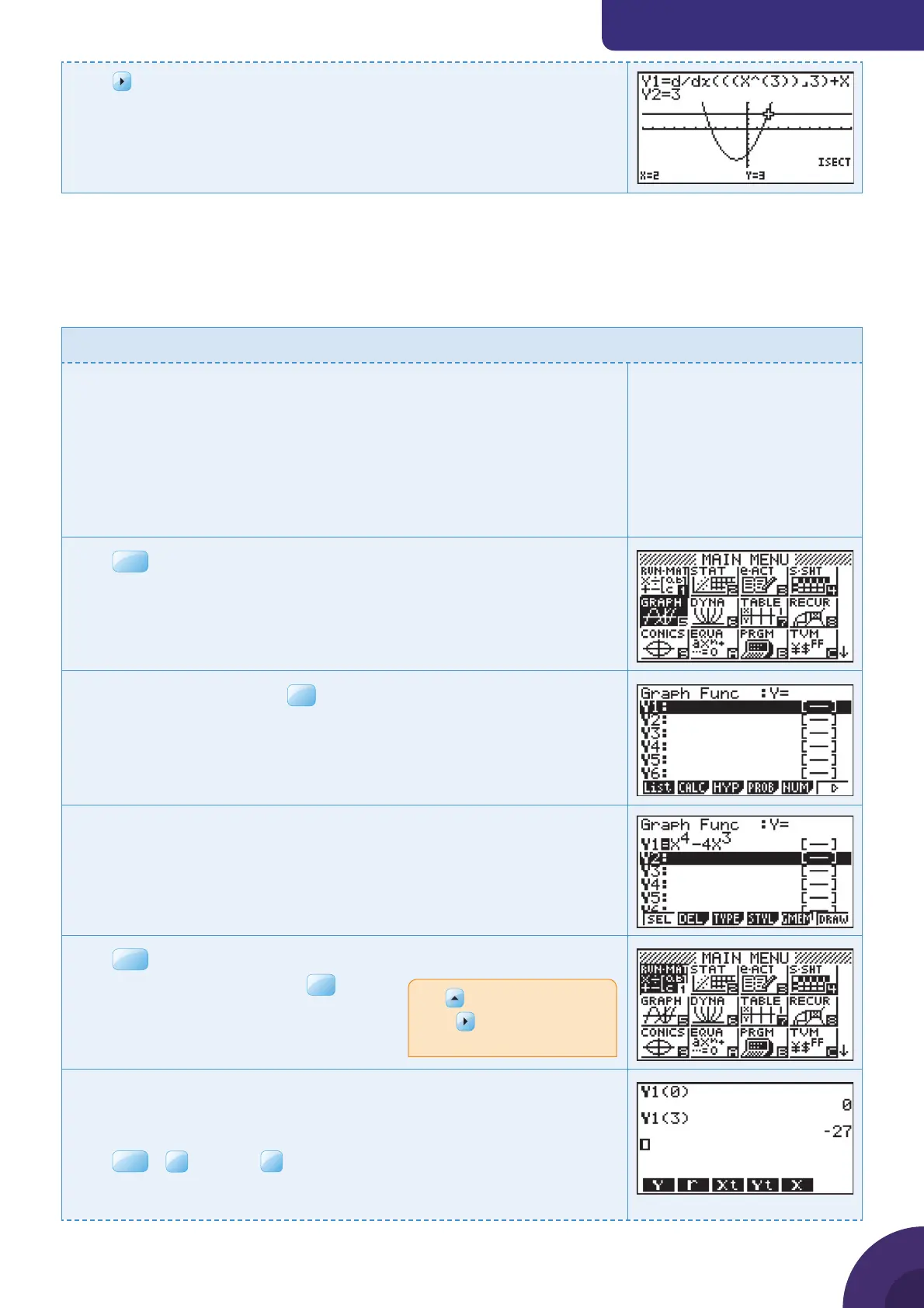
Press
to select the second point.
The GDC shows a point of intersection at (2, 3).
The curve has gradient 3 when x = –4 and x = 2.
2.6 Using the second derivative
The calculator can fi nd fi rst and second derivatives. The second derivative
can be used to determine whether a point is a maximum or minimum point.
Example 35
Find the stationary points on the curve f (x) = x
4
− 4x
3
and determine their nature.
f (x) = x
4
− 4x
3
f ′(x) = 4x
3
− 12x
2
At stationary points
f ′(x) = 0
4x
3
− 12x
2
= 0
4x
2
(x − 3) = 0
Therefore x = 0 or x = 3.
Press
MENU
. You will see the dialog box as shown on the right.
Choose 5: GRAPH and press
EXE
.
Enter x
4
− 4x
3
for Y1.
Press
MENU
. You will see the dialog box as shown on the right.
Choose 1: RUN·MAT and press
Use the calculator to fi nd the coordinates of the points and to
determine their nature.
Evaluate the function when x = 0 and x = 3.
Press
VARS
|
F4
GRPH |
F1
Y then type 1(0)l to enter Y1(0).
Similarly enter Y1(3).
The stationary points are at (0, 0) and (3, −27).
Use to enter the exponent.
Press
to return to the base
line.
{ Continued on next page
34



 To Next Page
 Loading...