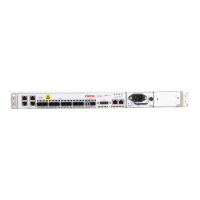
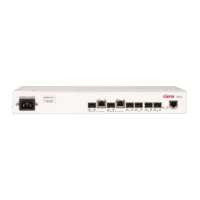
LE-3xx / LE-4xx Hardware Installation & User Guide
I
Ingress
refers to network traffic entering a
network device or the point on a device where
network traffic enters the device.
M
MPLS
(Multiprotocol Label Switching) is an IETF
initiative that sets up a specific path for a given
sequence of packets, identified by a label given
to each packet. MPLS allows most packets to
be forwarded at layer 2 rather than at layer 3.
P
PHB
(Per-Hop Behavior) is a description of the
externally observable forwarding treatment
applied at a differentiated services-compliant
node to a behavior aggregate.
PHBG
(Per-Hop Behavior Group) is a set of one
or more PHBs that can only be meaningfully
specified and implemented simultaneously,
due to a common constraint applying to all
PHBs in the set such as a queue servicing or
queue management policy.
Primary
is a redundancy state mode indicating
that the Active Control Module is managing the
system.
Provider
(or Service Provider) refers to an
entity who owns or administrates the network
over which services are offered. The provider
may or may not offer the services themselves.
Q
QoS
(Quality of Service) guarantees minimum
and maximum bandwidths for a service as well
as its priority relative to other services. QoS
policies consist of CIR, EIR, and priority.
R
RSTP
(Rapid Spanning Tree Protocol) is a
Layer 2 link management protocol defined in
IEEE 802.1W that provides network path
redundancy while preventing topology loops.
RSTP improves on STP (IEEE 802.1D) by
achieving much faster convergence times.
S
SAC
(Service Access Control) allows a provider
to control packet forwarding based on MAC
addresses, either by defining static MAC
addresses or by limiting the number of
dynamic MAC addresses that are allowed to
access the port.
Severity
the degree of urgency to which an
event is generally classified. Severity typically
lists three degrees of urgency; Critical, Major,
or Minor.
Spanning Tree Domains
is used in a network
that employs RSTP, a Spanning Tree Domain
limits the reach of RSTP to certain areas of the
network.
Standby
refers to the secondary Control
Module that will assume the role as the Active
Control Module in the event of failover.
Subscriber VLAN
is a VLAN ID that exists in a
subscriber’s private network that needs to be
preserved when traveling in the provider’s
network.
T
TLS
(Transparent LAN Services) allows two or
more LANs that are separated geographically
to be made to appear as one single LAN.
U
UMF
(Unknown Multicast Filtering) filters all
multicast streams that are not controlled by
IGMP snooping in order to prevent these
streams from being flooded to all ports on the
device.
V
Virtual Circuit
is a logical connection used to
carry a service.
VLAN
(Virtual Local Area Network) is a logical
element used to group resources that have a
common set of requirements together,
regardless of where they are located
physically.
VPLS
(Virtual Private LAN Service) is a class of
VPN that allows the connection of multiple sites
in a single bridged domain over a provider
managed MPLS network.
VPN
(Virtual Private Network) allows a
subscriber to seamlessly connect networks at
various locations and make them appear and
behave as if they were on the same physical
network.
W
WMF
(Well-known Multicast Filtering) allows
configured router protocols or other special
addresses in the multicast range (referred to
as well-known multicast groups) to be
forwarded when UMF is enabled.


 To Previous Page