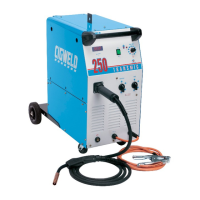
TRANSMIG 225, 255 MIG Power Source, 255 2R MIG Wirefeeder
Sep 16, 2008 5
SECTION 1: Arc Welding Safety Instructions and Warnings
WARNING 2
ARC WELDING can be hazardous.
Protect yourself and others from possible serious injury or death. Keep children away. Pace maker wearers keep away until
consulting your doctor. Do not lose these instructions. Read operating / instruction manual before installing, operating or
servicing this equipment.
Welding products and welding processes can cause serious injury or death, or damage to other equipment or property, if the operator does not strictly
observe all safety rules and take precautionary actions.
Safe practices have developed from past experience in the use of welding and cutting. These practices must be learned through study and training before
using this equipment. Anyone not having extensive training in welding and cutting practices should not attempt to weld. Certain practices apply to equipment
connected to power lines; other practices apply to engine driven equipment.
Safe practices are out lined in the American National Standard Z49.1 entitled: SAFETY IN WELDING AND CUTTING. This publication and other guides to
what you should learn before operating this equipment are listed at the end of these safety precautions.
HAVE ALL INSTALLATION, OPERATION, MAINTENANCE, AND REPAIR WORK PERFORMED ONLY BY QUALIFIED PEOPLE.
ELECTRIC SHOCK can kill.
Touching live electrical parts can cause fatal shocks
or severe burns. The electrode and work circuit is
electrically live whenever the output is on. The input
power circuit and machine terminal circuits are also
live when power is on. In semiautomatic or automatic
wire welding, the wire, wire reel, drive roll housing,
and all metal parts touching the welding wire are electrically live. Incorrectly
installed or improperly grounded equipment is a hazard.
1. Do not touch live electrical parts.
2. Wear dry, hole-free insulating gloves and body protection.
3. Insulate yourself from work and ground using dry insulating mats or
covers.
4. Disconnect input power or stop engine before installing or servicing
this equipment. Lock input power disconnect switch open, or remove
line fuses so power cannot be turned on accidentally.
5. Properly install and ground this equipment according to its Owner's
Manual and national, state, and 10 cal codes.
6. Turn off all equipment when not in use. Disconnect power to equipment
if it will be left unattended or out of service.
7. Use fully insulated electrode holders. Never dip holder in water to cool
it or lay it down on the ground or the work surface. Do not touch
holders connected to two welding machines at the same time or touch
other people with the holder or electrode.
8. Do not use worn, damaged, under sized or poorly spliced cables.
9. Do not wrap cables around your body.
10. Ground the workpiece to a good electrical (earth) ground.
11. Do not touch electrode while in contact with the work (ground) circuit.
12. Use only well-maintained equipment. Repair or replace damaged parts
at once.
13. In confined spaces or damp locations, do not use a welder with AC
output unless it is equipped with a voltage reducer. Use equipment with
DC output.
14. Wear a safety harness to prevent falling if working above floor level.
15. Keep all panels and covers securely in place.
ARC RAYS can burn eyes and skin;
NOISE can damage hearing.
Arc rays from the welding process produce intense heat
and strong ultraviolet rays that can burn eyes and skin.
Noise from some processes can damage hearing.
1. Wear a welding helmet fitted with a proper shade of filter (see ANSI
249.1 listed in Safety Standards) to protect your face and eyes when
welding or watching.
2. Wear approved safety glasses. Side shields recommended.
3. Use protective screens or barriers to protect others from flash and
glare; warn others not to watch the arc.
4. Wear protective clothing made from durable, flame-resistant material
(wool and leather) and foot protection.
5. Use approved earplugs or earmuffs if noise level is high.
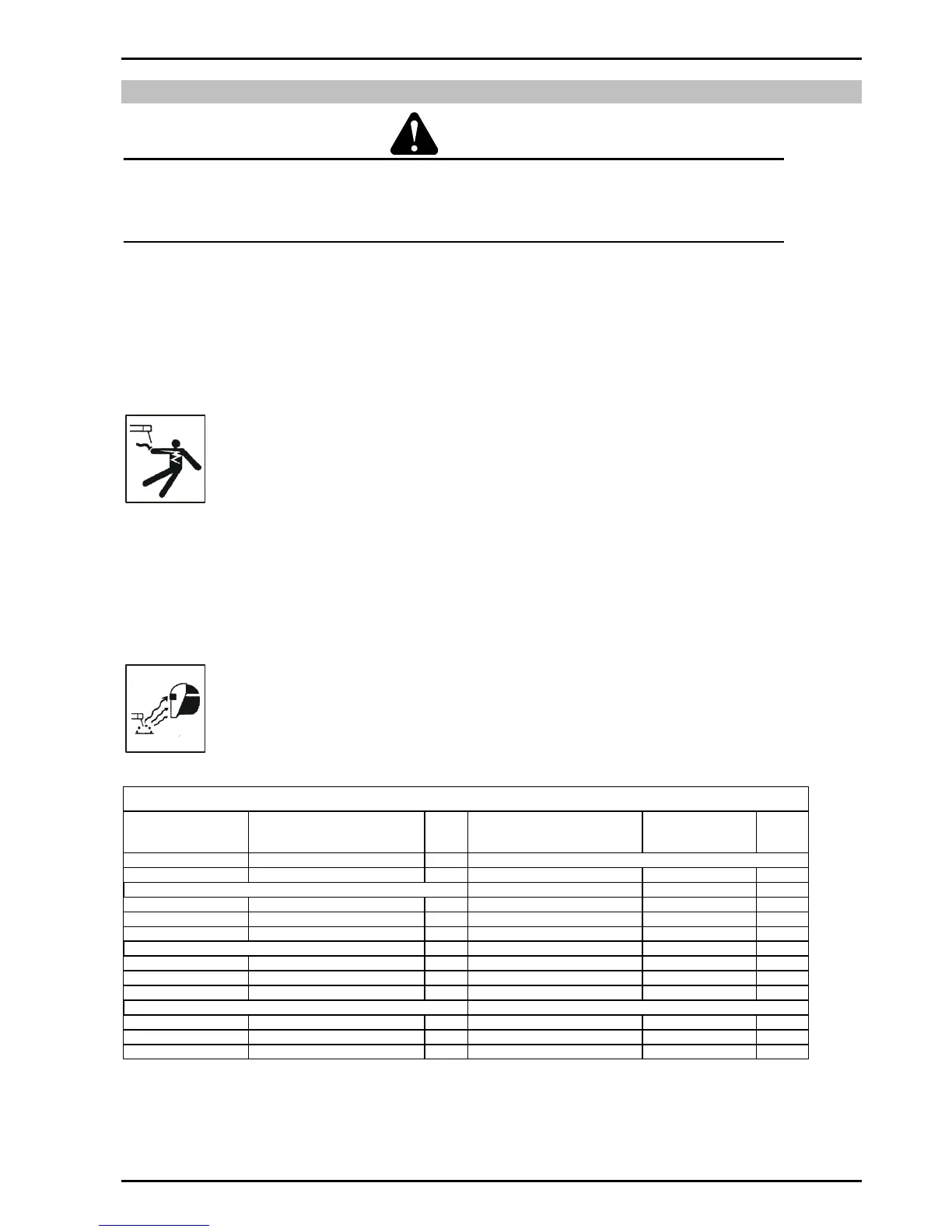
Eye protection filter shade selector for welding or cutting (goggles or helmet), from AWS A 8.2-73
Welding or Cutting
operation
Electrode size Metal Thickness or
Welding Current
Welding or Cutting operation
Electrode size Metal
Thickness or Welding
Current
Gas tungsten arc welding (TIG)
Shielded metal-arc welding (stick) electrodes
Under 5/32 to ¼ in., 4 to 6.4mm



 To Next Page