1-21
Cisco Aironet 1552 Series for Hazardous Locations Installation Guide
Chapter 1 Overview
Hardware Features
Warning
Class 1 laser product.
Statement 1008
The factory-orderable fiber option provides a fiber input and output capability. Fiber data is transmitted
and received over a single or dual-strand fiber cable, depending on the SFP, which is connected to the
access point using these SFP modules:
• 100BASE-BX10-U fiber rugged small-form factor pluggable (SFP) module
• 1000BASE-LX single-mode rugged SFP module
• 1000Base-SX multimode Rugged SFP module
Note SFP modules are not hot-swappable.
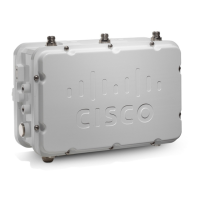
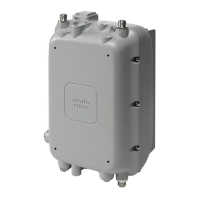
The 1552H and 1552S have one SFP port for fiber use, located on the bottom of the unit. The 1552H is
shown on Figure 1-1, and the 1552S is shown in Figure 1-2. Client data is passed to the network
controller through the fiber connection via a fiber-capable switch or controller. Configuration
information can be found in the controller configuration guide of the switch or controller you are using.
Metal Enclosure
The access point uses a metal enclosure that can accommodate both indoor or outdoor operating
environments and an industrial temperature operating range of –40 to 131°F (–40 to 55°C). The access
point complies with NEMA 4 and IP67 requirements.
Optional Hardware
Depending on the order configuration, the following optional access point hardware may be part of the
shipment:
• Cisco Aironet Antennas
• Pole mount kits (AIR-ACCPMK1550=, AIR-ACCPMK1550HZM=)
• Band installation tool for pole mount kit (AIR-BAND-INS-TL=)
• Power injector (AIR-PWRINJ1500-2=)
Caution Caution: Power injector (AIR-PWRINJ1500-2=) is not certified for installation within hazardous
locations environments.
• 1000BASE-LX single-mode rugged SFP (GLC-LX-SM-RGD=)
• 1000BASE-SX multimode rugged SFP (GLC-SX-MM-RGD=)
Network Deployment Examples
The access point is a wireless device designed for wireless client access and point-to-point bridging,
point-to-multipoint bridging, and point-to-multipoint mesh wireless connectivity. The access point
provides 5 GHz backhaul capability to link with another access point to reach a wired network
connection or to provide repeater operations for other access points.
The access point plays two primary radio roles: a root access point (RAP) or a mesh (non-root) access
point (MAP), which is the default role of all access points. When the access point has a fiber or wired
Ethernet or cable connector connection to the controller (through a switch), the radio role is called a



 To Next Page