38-8
Cisco Catalyst Blade Switch 3130 and 3032 for Dell Software Configuration Guide
OL-12247-04
Chapter 38 Configuring IP Unicast Routing
Configuring IP Addressing
Classless Routing
By default, classless routing is enabled when the switch is configured to route. With classless routing, if
a router receives packets for a subnet of a network with no default route, the router forwards the packet
to the best supernet route. A supernet is contiguous blocks of Class C address spaces simulating a single,
larger address space and is designed to relieve the pressure on the rapidly depleting Class B address
space.
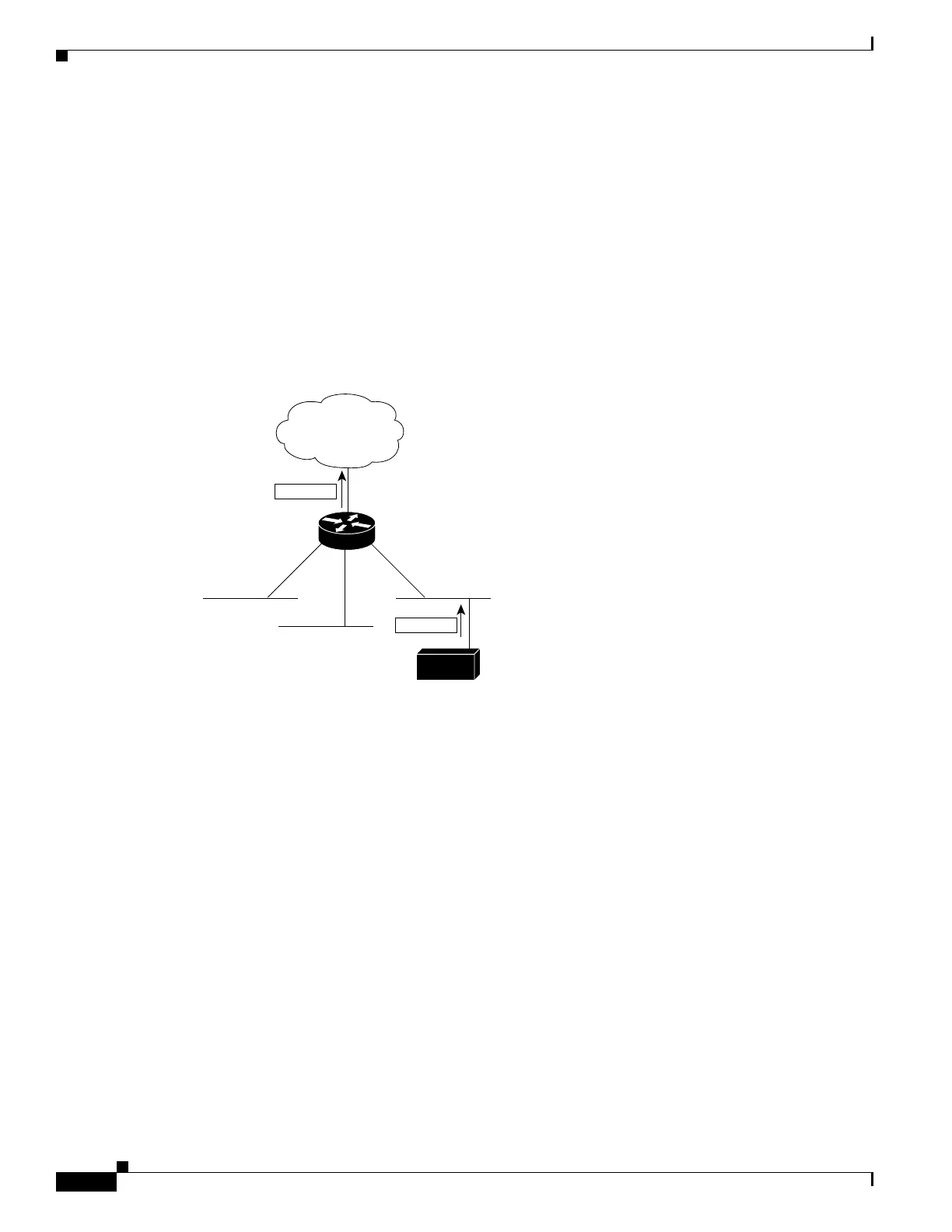
In Figure 38-2, classless routing is enabled. When the host sends a packet to 120.20.4.1, instead of
discarding the packet, the router forwards it to the best supernet route. If you disable classless routing
and a router receives packets destined for a subnet of a network with no network default route, the router
discards the packet.
Figure 38-2 IP Classless Routing
In Figure 38-3, the router in network 128.20.0.0 is connected to subnets 128.20.1.0, 128.20.2.0, and
128.20.3.0. If the host sends a packet to 120.20.4.1, because there is no network default route, the router
discards the packet.
Host
128.20.1.0
128.20.2.0
128.20.3.0
128.20.4.1
128.0.0.0/8
128.20.4.1
IP classless
45749
128.20.0.0


 To Next Page