Inspection and Maintenance
7-10
750-96 (revised 2010)
Model CB Packaged Boiler Manual
7.10 — Solenoid Valves
Foreign matter between the valve seat and seat disc can cause leakage. Valves are readily disassembled; how-
ever, care must be used during disassembly to be sure that internal parts are not damaged during the removal
and that reassembly is done in proper order.
A low hum or buzzing will normally be audible when the coil is energized. If the valve develops loud buzzing or a
chattering noise, check for proper voltage and clean the plunger assembly and interior plunger tube thoroughly.
Do not use any oil. Make sure that the plunger tube and solenoid are tight when reassembled. Take care not to
nick, dent, or damage the plunger tube.
Coils may be replaced without removing the valve from the line. Be sure to turn off power to the valve. Check the
coil position and make sure that any insulating washers or retaining springs are reinstalled in proper order.
7.11 — Cam Spring
The fuel cam profile spring should be inspected frequently for wear, scoring or distortion. If any of these question-
able conditions are found, the spring must be replaced immediately to avoid the possibility of breakage in service.
Use care to avoid damaging the spring during installation.
Lubricate occasionally with a non-gumming, dripless, high-temperature lubricant such as graphite or a silicone
derivative.
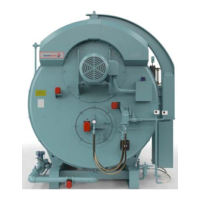
7.12 — Forced Draft Fan
The position of the fan housing and the clearance between it and the fan (impeller) is extremely important to the
output capacity of the fan.
To install and adjust:
1. Bolt the motor securely to the head.
2. Slide the fan onto the shaft, but do not tighten setscrews.
3. Turn spacers on studs until they contact the headplate.
4. Install the fan housing on the studs after placing an external tooth lock washer next to the spacer. Hold the fan
housing in place with nuts and lock washers. Tighten by hand. Do not over tighten.
5. Slide the fan until its vanes touch the fan housing. All blades must be against the housing. If necessary, adjust
the spacers until the housing is evenly set against all blades. Tighten the nuts to secure the housing in place.
6. Slide the fan toward the motor and use a feeler gauge to obtain a clearance between .035” and .045”.
7. Tighten the setscrew on the key first and then tighten the setscrew at 90º from the key.
8. Install the air duct assembly through the opening in the head. Tighten the screws securing the air duct to the
fan housing only enough to create a seal between the neoprene gasket and the housing.
9. After connecting the motor leads, check the rotation of the impeller to be sure that it is counterclockwise when
viewed from the motor end.








 To Next Page