Assembly Language: A machine-oriented language in which
mnemonics are used to represent each machine-language
instruction. Each CPU has its own specific assembly
language. See CPU and machine language.
Assignment Statement: A BASIC statement that sets a variable,
constant or array element to a specific numeric or string
value.
Asynchronous Transmission: A scheme in which data characters
are sent at random time intervals. Limits phone-line
transmission to about 2,400 baud (bps). See Synchronous
Transmission.
Attack: The rate at which the volume of a musical note rises from
zero to peak volume.
Background Color: The color of the portion of the screen that the
characters are placed upon.
BASIC: Acronym for Beginner’s All-purpose Symbolic Instruction
Code.
Baud: Serial-data transmission speed. Originally a telegraph term,
300 baud is approximately equal to a transmission speed of
30 bytes or characters per second.
Binary: A base-2 number system. All numbers are represented as
a sequence of zeros and ones.
Bit: The abbreviation for Binary diglT. A bit is the smallest unit in
a computer. Each binary digit can have one of two values,
zero or one. A bit is referred to as enabled or "on” if it equals
one. A bit is disabled or “off” if it equals zero.
Bit Control: A means of transmitting serial data in which each bit
has a significant meaning and a single character is
surrounded with start and stop bits.
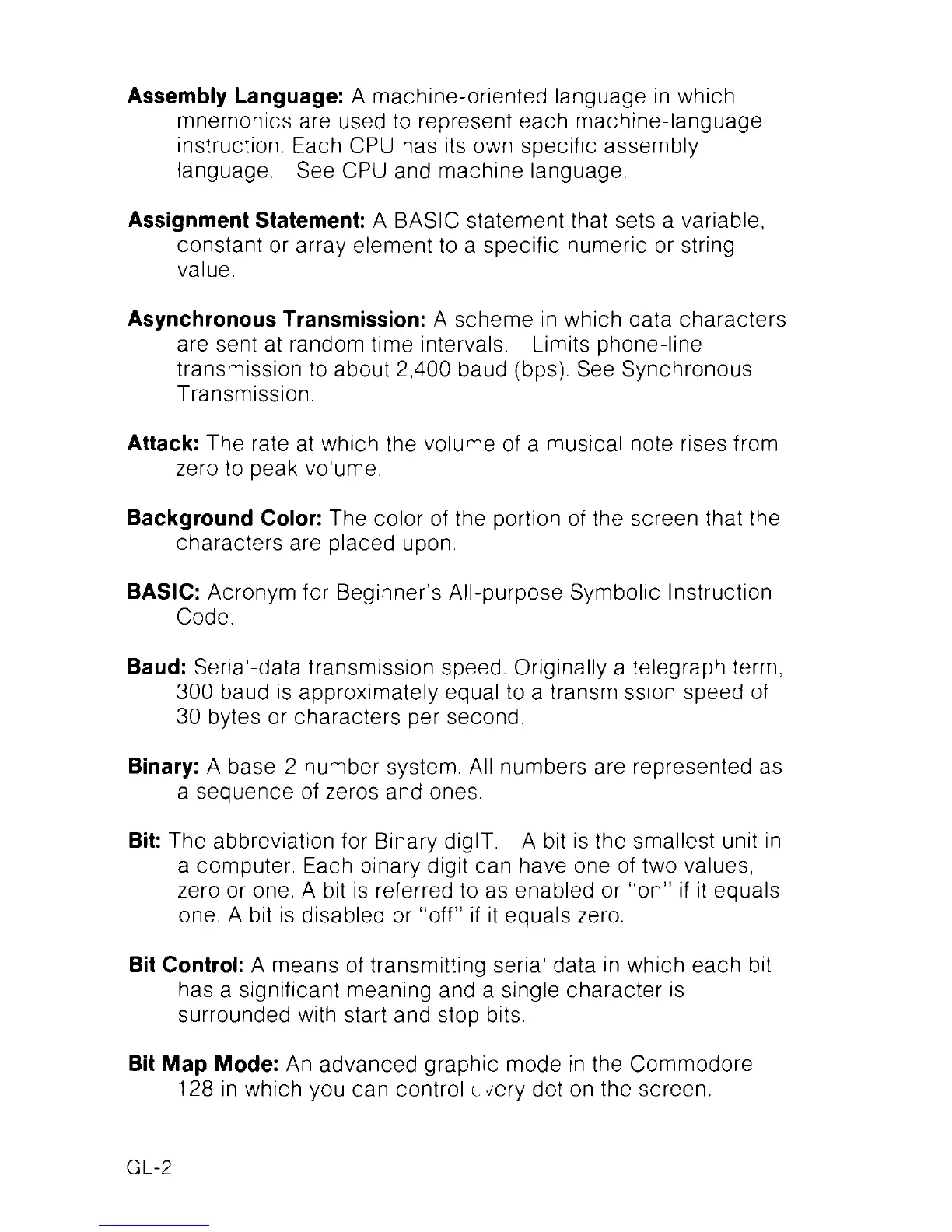
Bit Map Mode: An advanced graphic mode in the Commodore
128 in which you can control every dot on the screen.
GL-2



 To Next Page