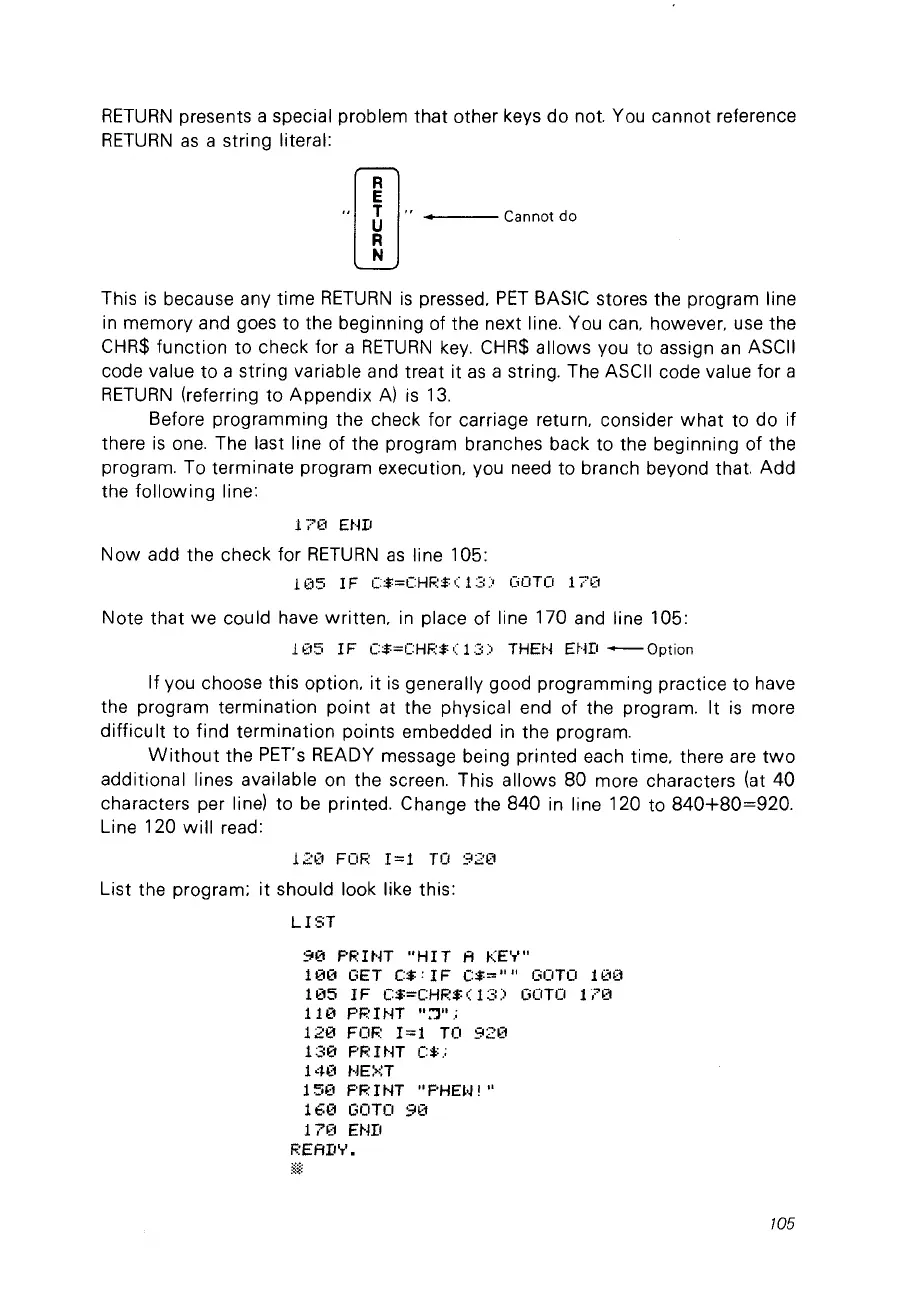
RETURN
presents a special problem
that
other keys
do
not. You cannot reference
RETURN
as
a string literai:
H
]"
...
---
Cannat do
This
is
because any time
RETURN
is
pressed.
PET
BASIC stores the program line
in
memory and goes to the beginning of the next line. You can, however, use the
CHR$
function to check for a
RETURN
key.
CHR$
allows vou to assign an ASCII
code value to a string variable and treat it
as
a string. The ASCII code value for a
RETURN
(referring to Appendix
A)
is
13.
Before programming the check for carriage return, consider
what
to
do
if
there
is
one.
The last line of the program branches back to the beginning of the
program. To terminate program execution, vou need to branch beyond that. Add
the
following
line:
17(1 END
Now
add the check for
RETURN
as
line 105:
1(15
IF
C$=CHR$(13)
GOTO
17(1
Note that
we
could have written.
in
place of line 170 and line 105:
1
(15
1F C$=CHF.:$ ( 1
:::::)
THEN
Hm
- Option
If vou choose this option. it
is
generally good programming practice to have
the program termination point at the physical end of the program. It
is
more
difficuIt to find termination points embedded in the program.
Without
the PETs READY message being printed each time. there are
two
additional lines available
on
the screen. This allows 80 more characters (at
40
characters per line) to
be
printed. Change the 840 in line 120 to
840+80=920.
Line 120
will
read:
120
FOR
1=1
TO
920
List the program: it should look like this:
LIST
90
PRINT
"HIT
A
KEY"
100
GET
CS:
IF
C$:::""
GOTO
lü(1
1(15
IF
C$=CHR$(13)
GOTO
110
Ile
PRHn
"j".:
120
FOR
1=1
TO
920
130
PF~I~n
C:$:.;
141;1
t·jE:>n
151;1
PF.:
1NT
"PHEI·J!"
160
OOTO
90
170
E~m
F.:EADY.
105



 To Next Page