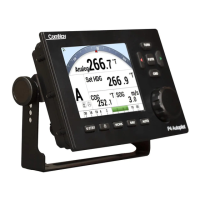
ComNav 1500 / 1510 Autopilot - 6 -
2. INSTALLATION
2.1 General Comments
More than any other piece of marine electronics, reliable and accurate operation of
an Autopilot depends on correct installation. Please read and be sure you fully
understand the installation requirements before attempting installation.
The installation includes 6 major steps:
1.
Read the installation and operation manual completely
.
2. Plan where to install the equipment.
3. Run the cables.
4. Install the
transducers and instruments.
3. Make the attachments needed for Pumpset and cylinder and
install them.
6. Learn the function
s and calibrate your system.
Before you begin drilling ... think about how you can make the installation as neat
and simple as your boat will allow. Plan where to position the transducers, Server
and instruments. Think about leaving space for additional instruments in the future.
A few ”do nots” you should consider:
• Do not cut the cables too short. Allow extra cable length at the Distribution
Box (Servo Unit) so it can be disconnected for inspection without having to
disconnect all attached cables.
• Do not place sealant behind the display. The instrument gasket eliminates
the need for sealant.
• Do not run cables in the bilge, where water can appear.
• Do not run cables close to fluorescent light sources, engine or radio
transmitting equipment to avoid electrical disturbances.
• Do not rush; take your time. A neat installation is easy to do.
The following tools and materials will be needed:
• Wire cutters and strippers.
• Small and large Philips and small flat head screw driver.
• Hole saws: 63mm OD (2½") and 89mm OD (3 ½”).
• Drill bit for 5mm OD (1/4").
• Plastic cable ties
If you are doubtful about the installation, obtain the services of an experienced
technician.


 To Next Page