Menu 4
Parameter
structure
Keypad and
display
Parameter x.00
Parameter
description format
Advanced parameter
descriptions
Serial comms
protocol
Electronic
nameplate
Performance
74 Digitax ST Advanced User Guide
www.controltechniques.com Issue Number: 1
The proportional gain Kp (Pr 4.13) is the most critical value in controlling the performance of the current controllers. Either the value can be set by
auto-tuning (see Pr 5.12), or it can be set by the user so that
Kp = (L / T) x (Ifs / Vfs) x (256 / 5)
Where:
T is the sample time of the current controllers. The drive compensates for any change of sample time, and so it should be assumed that the
sample time is equivalent to the lowest sample rate of 167μs.
L is the motor inductance. This is half the phase to phase inductance that is normally specified by the manufacturer. This is the inductance value
stored in Pr 5.24 after the auto-tune test is carried out.
I
fs
is the peak full scale current feedback = Kc x √2 / 0.45. Where Kc is the current scaling for each size of drive.
V
fs
is the maximum DC bus voltage.
Therefore:
Kp = (L / 167us) x (Kc x √2 / 0.45 / Vfs) x (256 / 5)
= K x L x Kc
Where:
K = √2 / (0.45 x V
fs
x 167μs) x (256 / 5)
There is one value of the scaling factor K for each drive voltage rating as shown in the table below
The integral gain Ki (Pr 4.14) is less critical and should be set so that
Ki = Kp x 256 x T /
τ
m
where
τ
m
is the motor time constant (L / R).
R is the per phase stator resistance of the motor (i.e. half the resistance measured between two phases).
Therefore
Ki = (K x L x Kc) x 256 x 167us x R / L
= 0.0427 x K x R x Kc
The above equations give the gain values that are calculated by the auto-tune system and these should give the best response at all switching
frequencies with minimal overshoot. If required the gains can be adjusted to improve performance as follows:
1. The integral gain (Ki) can be used to improve the performance of the current controllers by reducing the effects of inverter non-linearity. These
effects become more significant with higher switching frequency. These effects will be more significant for drives with higher current ratings and
higher voltage ratings. If Ki is increased by a factor of 4 it is possible to get up to 10% overshoot in response to a step change of current
reference. For high performance applications, it is recommended that Ki is increased by a factor of 4 from the auto-tuned values. As the inverter
non-linearity is worse with higher switching frequencies it is may be necessary to increase Ki by a factor of 8 for operation with 16kHz switching
frequency.
2. It is possible to increase the proportional gain (Kp) to reduce the response time of the current controllers. If Kpi is increased by a factor of 1.5 then
the response to a step change of reference will give 12.5% overshoot. It is recommended that Ki is increased in preference to Kpi.
As already stated, the drive compensates for changes of switching frequency to give similar performance as the switching frequency changes. The
following table gives the relationship between the user gain values and the values actually used by the drive.
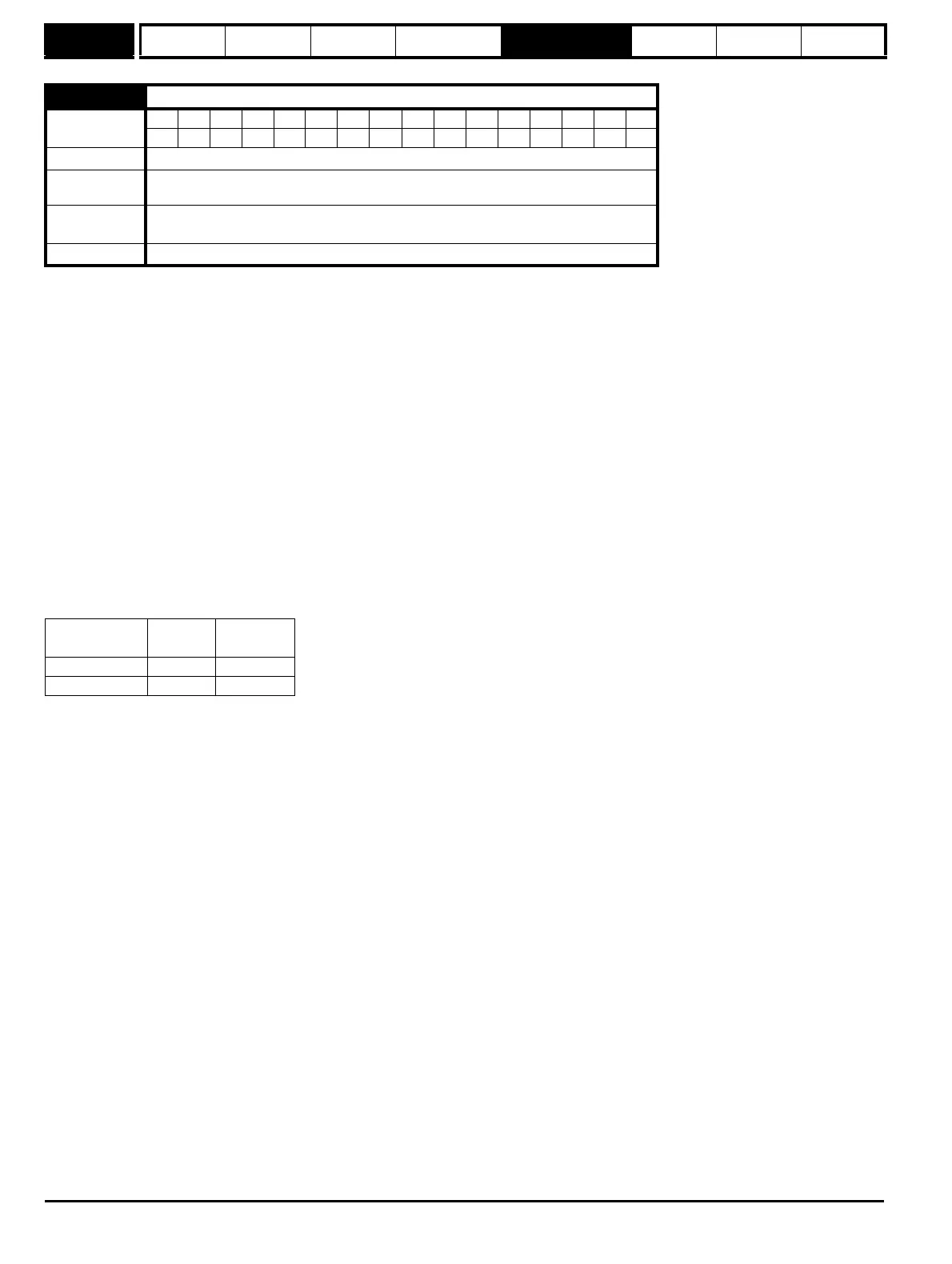
4.14 Current controller Ki gain
Coding
Bit SP FI DE Txt VM DP ND RA NC NV PT US RW BU PS
111
Range 0 to 30,000
Default
200V drive: 1,000
400V drive: 2,000
Second motor
parameter
Pr 21.23
Update rate Background read
Drive voltage
rating
V
fs
K
200V 415V 2,322
400V 830V 1,161


 To Next Page