Instruction for use
27
REQUIREMENT: Avoid release to the environment fuels and / or containers, but
please do so in an environmentally and local regulations.
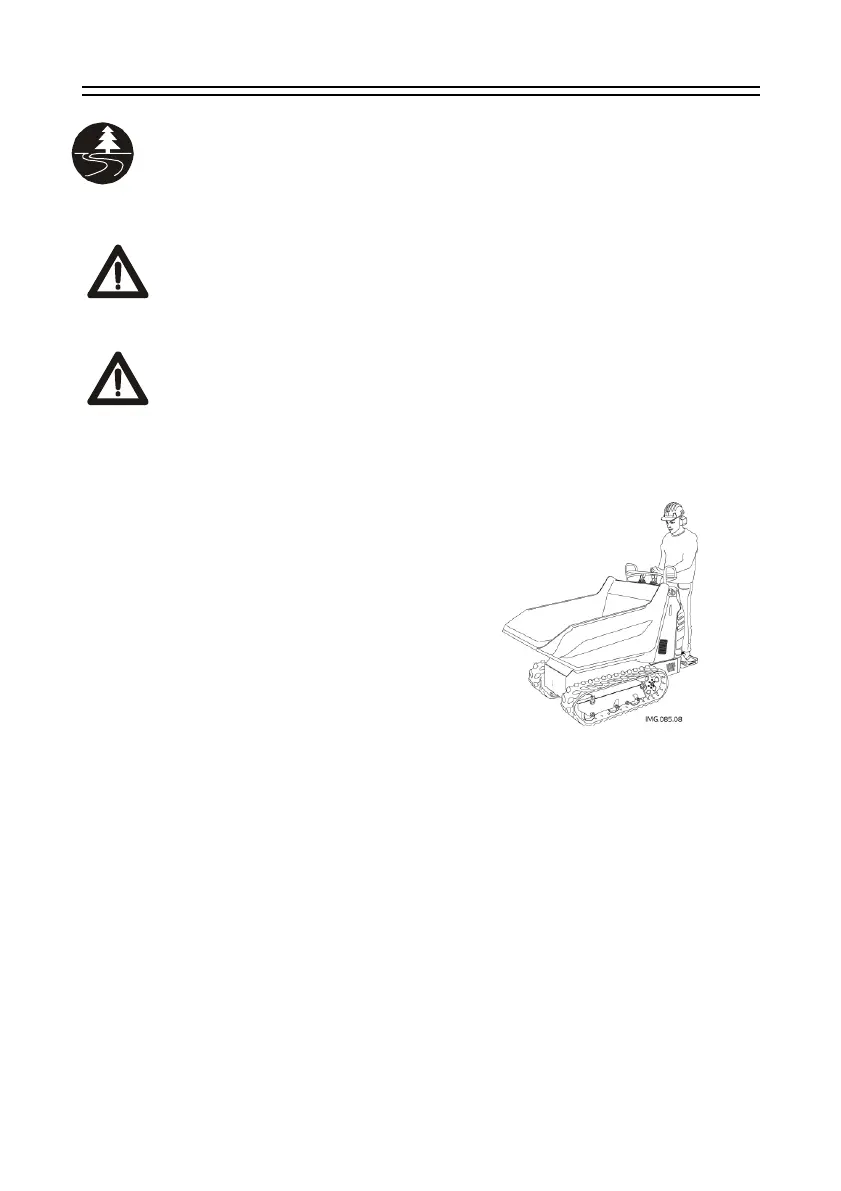
3.5 DRIVING THE MACHINE
DANGER: Always avoid overloading the machine above the prescribed limits:
during movement, an overload could create structural variations that were
not foreseen and could provoke the overturning of the machine with serious
safety consequences.
WARNING: Where possible, try to avoid travelling on rocky or icy terrain, on
rails and railway sections because they may damage the tracks and reduce
their longevity. Also avoid passing over material that could ruin the tracks,
such as sharp objects, pieces of metal, etc. that could get caught up in the
tracks and provoke a break.
At the start-up, regulate the number of rotations of the engine to the desired lev-
el by activating the accelerator lever, ac-
cording to the required power (when the
machine is loaded, you must bring the lever
above the halfway mark between the mini-
mum and maximum).
Under some conditions, especially when the
machine is loaded or going uphill, a loss of
engine power may occur because of a motor
overload; this may also cause it to shut
down. In this case, slowly release the drive
command lever, regulating the speed to a
level that does not provoke an overload of
the propeller.
Your machine is equipped with a hydrostatic transmission, so, it is not necessary
that the rotations of the engine be at maximum for the displacement. Leave the
engine operating at its maximum number of rotations does not improve the func-
tioning of the machine, rather, it certainly (and uselessly) increases its fuel con-
sumption: it is advisable, therefore, to increase the rotations of the engine only
where it is absolutely necessary (to proceed at maximum speed, to address steep
slopes with a full load, etc.).
.
fig. 17 – Driving position



 To Next Page