User Guide DDOC0099-000-AH
DTS1 CSfC 2 - 7 Overview
© 2020 Curtiss-Wright Defense Solutions Revision 5.0
• Supported block data transfer protocol
• iSCSI
• Supported packet capture protocol
• PCAP
• Supported video stream capture protocol
• RTP
• Client remote boot from DTS1 via Preboot eXecution Environment (PXE)
• User control, status, & maintenance interface
• Command Line Interface (CLI) via:
• Secure shell (SSH)
• Serial RS-232
• Ethernet
• SNMP via Ethernet
• Rear panel connections
• J1: Power input
• Remote Power Disable
• MIL-STD-704E compliant +28VDC
• 20 Watts maximum power dissipation
• 1.3 Amps peak inrush current
• J2: Ethernet interface, RS-232, Reset, and Zeroization
• 10/100/1000 copper
• IEEE 802.3, 802.u, and 802.ab
• RS-232 serial communications
• Zeroize discrete
• Reset (reboot) discrete
• J3: Ethernet interface
• 10/100/1000 copper
• IEEE 802.3, 802.u, and 802.ab
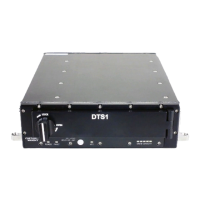
• Front panel controls and indicators
• POWER LED (green)
• FAULT LED (red)
• KEY LOADED LED (yellow)
• DRIVE CAPACITY LEDs
• KEY CLEAR Button
• Built In Test (BIT) capability
• Provides overall health and status and out-of limits detection and notification
• Start-up BIT (SBIT) (displayed upon start up)
• Periodic BIT (PBIT)
• Initiated BIT (IBIT)
• Maintenance BIT (MBIT)
• Test control via CLI, health status query via CLI and SNMP
• Environmental
• Temperature
• Operating: -45 to +55°C (+71°C for 30 minutes)
• Storage: -45 to +85°C
• Operational Random Vibration
• 1 hour per axis: 0.02 g2/Hz from 5 Hz to 2 kHz
• Operational Shock
• Each axis: 20 impact shocks of 20 g’s, 10 msec, 2 kHz frequency range
• MIL-STD-810 Half Sine
• MIL-STD-810 Terminal Peak Sawtooth
• MIL-STD-810 Initial Peak Sawtooth
• Total of 60 impacts per unit
• Non-operational Crash Safety
• Each axis: 20 impact shocks of 40 g’s, 8 msec, 2 kHz frequency range
• In accordance with MIL-STD-810, Method 516.4, Procedure C
• In accordance with MIL-STD-810, Method 516.4, Procedure V


 To Next Page
